G2C Brief — System One models: decisions without generation
Question this Brief answers: What do you get if a language model reads its input once and never writes a word?
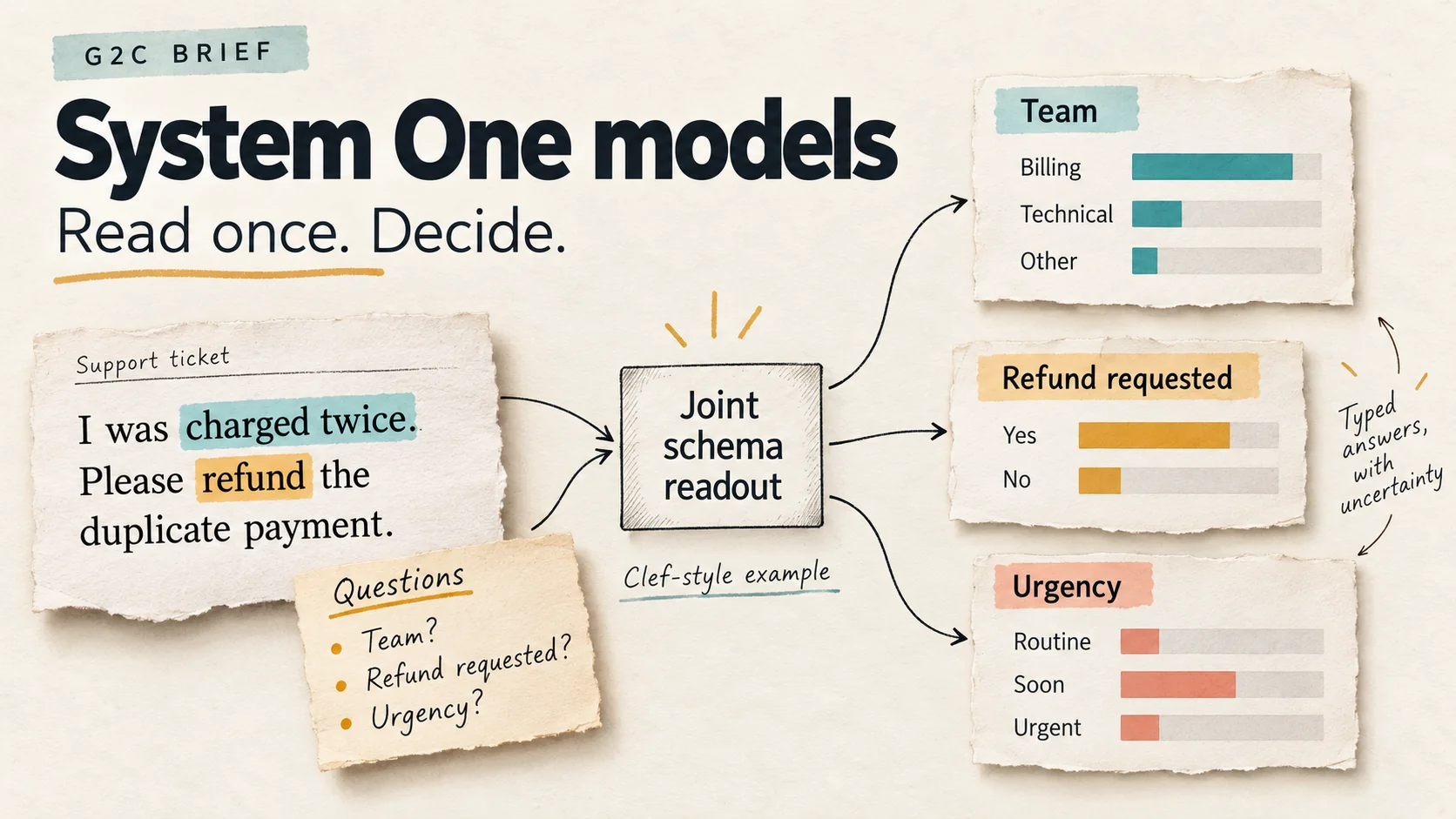
On October 19, 2026, Cloudflare released a preview of Clairic, which it calls the first of "a new System One class of extraction models." Give it a receipt and ask for the total, the date, and the vendor, and it returns a number, a date, and a span of the input. It does not generate any text. Clairic is the newest entry in a category that barely existed five weeks ago. TypeSafe named the category in mid-September, and since then Ollama, Cloudflare, Liquid AI, Together AI, Bespoke Labs, and the vLLM project have all shipped models or infrastructure for it.
The pitch is simple. A lot of what production software asks a language model to do isn't writing. It's deciding: which team gets this ticket, is this request harmful, should this invoice be paid, held, or rejected? The usual answer is to have an LLM generate JSON, parse it, and hope. A System One model skips the generation step entirely. It reads the input and a schema of typed questions in one forward pass and returns a probability for every allowed answer.
A g2c graduate has built almost every piece of this. You scored multiple-choice answers from a model's logits and measured calibration in Module 15. You froze a base model and trained a low-rank adapter in Module 13B. You made malformed JSON impossible with a grammar mask in Module 18, and you learned there that a guarantee about format is not a guarantee about content. You measured prefill against decode in Module 16. System One models are those pieces rearranged, plus one new component: a small head that reads the questions and their options out of the prompt itself.
This Brief covers the category, not one release. It anchors on Cloudflare's Clef because its weights and head source code are public, so the architecture section can be read from code rather than from a blog post.
Snapshot
| Subject | "System One" or "decision" models: models that answer typed questions in a single pass instead of generating text |
| Newest release | Clairic (Cloudflare, October 19, 2026). Hosted preview only; weights "soon." |
| Anchor model | Clef (27B) and Clef-flash (9B), Cloudflare, October 1, 2026. Apache 2.0, with head source code (joint_schema_model.py) and config. |
| Origin | TypeSafe: "Introducing System One models and Jev", September 15, 2026. Jev is hosted only; its architecture is not disclosed. |
| Other implementations | Ollama 0.35 local /v1/systemone endpoint with Bespoke Labs' Nimble and Together AI's Tev1 (September 29); Clef-omni (October 9); vLLM Semantic Router's Decision 3.0 family on vLLM nightly (October 14–15); Liquid AI's d1 family; a Pydantic AI model class |
| Independent evaluation | Typed Decisions, a community benchmark not affiliated with any vendor |
| Technical reports | None. Sources are blog posts, model cards, API docs, and Clef's released code. |
| Last verified | October 19, 2026. Clef repo at commit a30162b, Clef-flash at f0b7d3c, Typed Decisions card at e742f0a. |
The labels follow the standard Brief meanings:
- Reported: a claim or number from the organization that made the model, or from the benchmark's maintainers. Nearly every speed and quality number in this area is self-reported.
- Derived: arithmetic from disclosed values or from the released code, with the working shown.
- G2C interpretation: this Brief's reading or connection.
- Not disclosed: what the sources don't say.
Where Clef's code and Cloudflare's blog disagree or differ in detail, this Brief treats the code as authoritative.
The idea in one picture
Here is the same request handled two ways. A support ticket arrives, and you want a team, a yes/no on whether a refund is requested, and an urgency level.
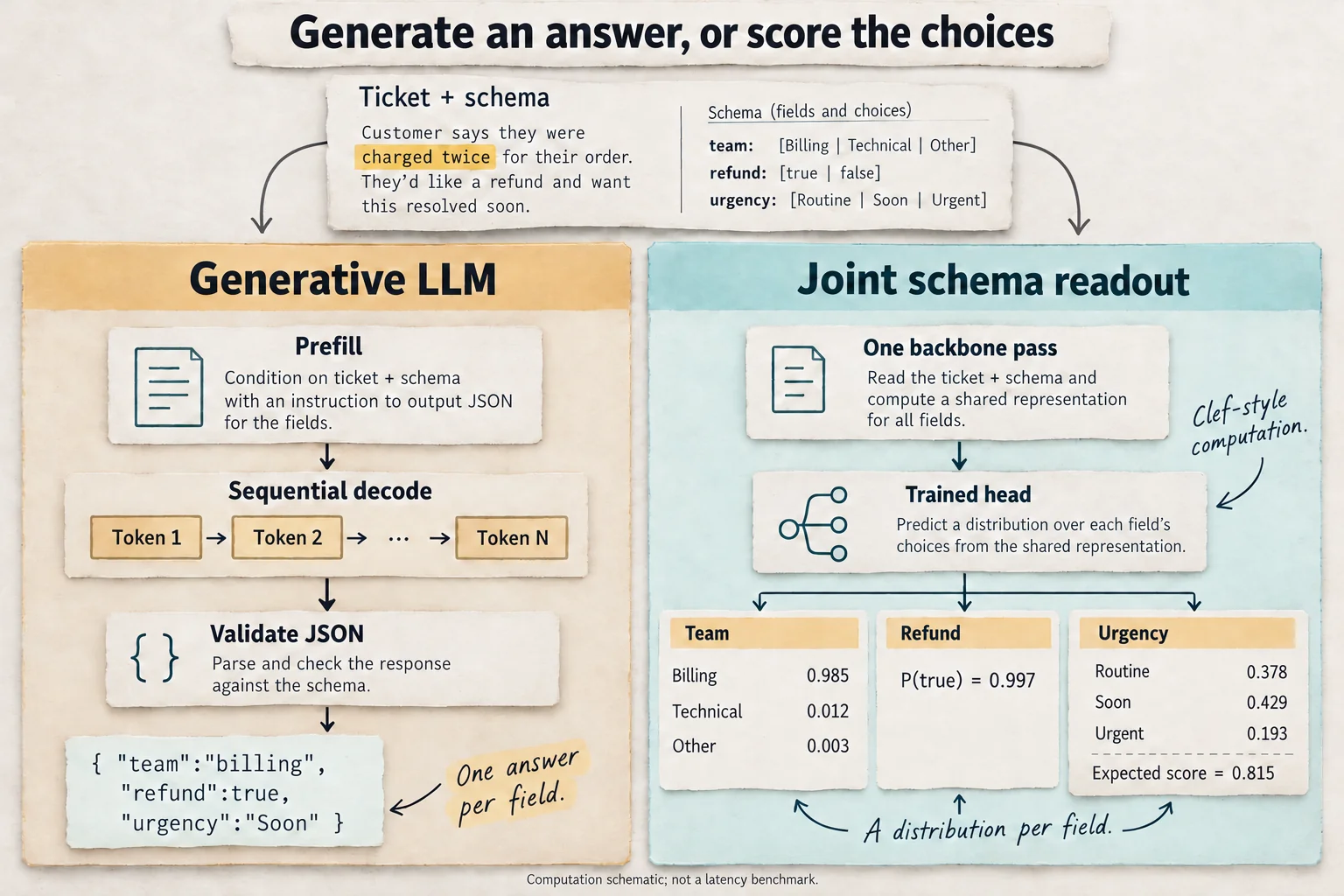 Two computation paths. G2C interpretation: the paths contrast sequential generation with a joint schema readout. Reported: the displayed probabilities come from Ollama's Nimble example, reused to illustrate the output shape; they are not Clef measurements or a timing comparison. Other decision-model readouts differ, as the next architecture section explains.
The request shape on the right, called the System One API, has become a shared
interface. TypeSafe defined it for Jev. Cloudflare's Clef, Ollama's local
server, vLLM's Decision 3.0 serving, Liquid AI, and several community models
accept the same POST /v1/systemone body. A request has a state, which can be
text, JSON, or for some models images, audio, or video, and a map of named
questions. There are three question types:
| Type | You supply | You get back |
|---|---|---|
noul |
a yes/no proposition | the probability that it's true |
choice |
named options, each with a description | a probability per option, the top choice, and a confidence |
score |
an ordered list of levels | a probability per level, and an expected score that can fall between levels |
Derived. The "score" output is just an expectation over the level
probabilities. For the urgency answer above:
0×0.378 + 1×0.429 + 2×0.193 = 0.815.
Option descriptions are part of the input. The model reads "billing: Payments and refunds" in the prompt, so the same model can answer a schema it has never seen. That property is the heart of the category.
An old idea with three new parts
G2C interpretation. Reading a decision out of a network's hidden state instead of generating text is not new. A Module 03 MNIST classifier does it. So do BERT-style classifiers, search rerankers that score a query against a document, and the reward models behind RLHF, which put a scalar head on a language model. And in Module 15 you already scored answer options from a language model's logits instead of sampling. TypeSafe's framing as "a new class of frontier models" sells that history short.
What is genuinely new is three things together:
- The options are input, not output rows. A classifier has one weight row per class, fixed at training time. A System One model reads the classes, and what they mean, from the prompt. That makes it a general-purpose tool rather than one classifier per task.
- Calibration is a training objective. These models are trained with losses that reward honest probabilities, not just correct top answers. That makes the probabilities usable for routing: act automatically above 0.9, send to a human below.
- There is a shared API. A typed request and response that several vendors and two local runtimes accept means software can swap one decision model for another, the way it swaps LLM providers today.
The name comes from Daniel Kahneman's Thinking, Fast and Slow: fast, intuitive System 1 versus slow, deliberate System 2. Reported. TypeSafe concedes that "System 1" usually connotes error-prone thinking, and argues these models can be made reliable anyway. The analogy is apt in one respect that matters later: a single forward pass cannot deliberate.
Three ways to read a decision out of a language model
The category hides real architectural variety. These are the three readouts you can find in public code or documentation, from most familiar to least.
1. Score each option's tokens (Module 15). For each candidate answer, run the model over prompt + answer, sum the log-probabilities of the answer's tokens, and softmax across candidates. This is your closed-set evaluator. It needs no training, but costs one pass per option (or one large batch), and long option strings get penalized for length.
2. Read answer codes at the last token (vLLM's Decision 3.0). Reported. The Decision 3.0 recipe describes "one forward pass per question, whose readout scores that question's options at the last token." Put the options in the prompt with short codes, and read the logits of those codes at the final position. This is close to the familiar trick for scoring MMLU-style multiple choice by the letters A, B, C, D. It costs one pass per question. Reported. The recipe also says its full-attention layers "read the prompt in both directions," so it turns off prefix caching. G2C interpretation. Attention that looks both ways is only possible because the model never has to generate: there is no future token to hide.
3. A joint schema head over the whole prompt (Clef). One pass for all questions, then a small trained transformer reads the backbone's hidden states for each question and option and scores them together. This is the design worth looking at closely, because its code is public.
| Readout | Backbone passes per request | Trained head? | Questions see each other? |
|---|---|---|---|
| Option-token scoring (Module 15) | one per option | no | no |
| Last-token answer codes (Decision 3.0) | one per question | readout only (Not disclosed) | no |
| Joint schema head (Clef) | one | yes, about 128M parameters | yes |
| An LLM generating JSON | 1 prefill + 1 per output token | no | through the text it writes |
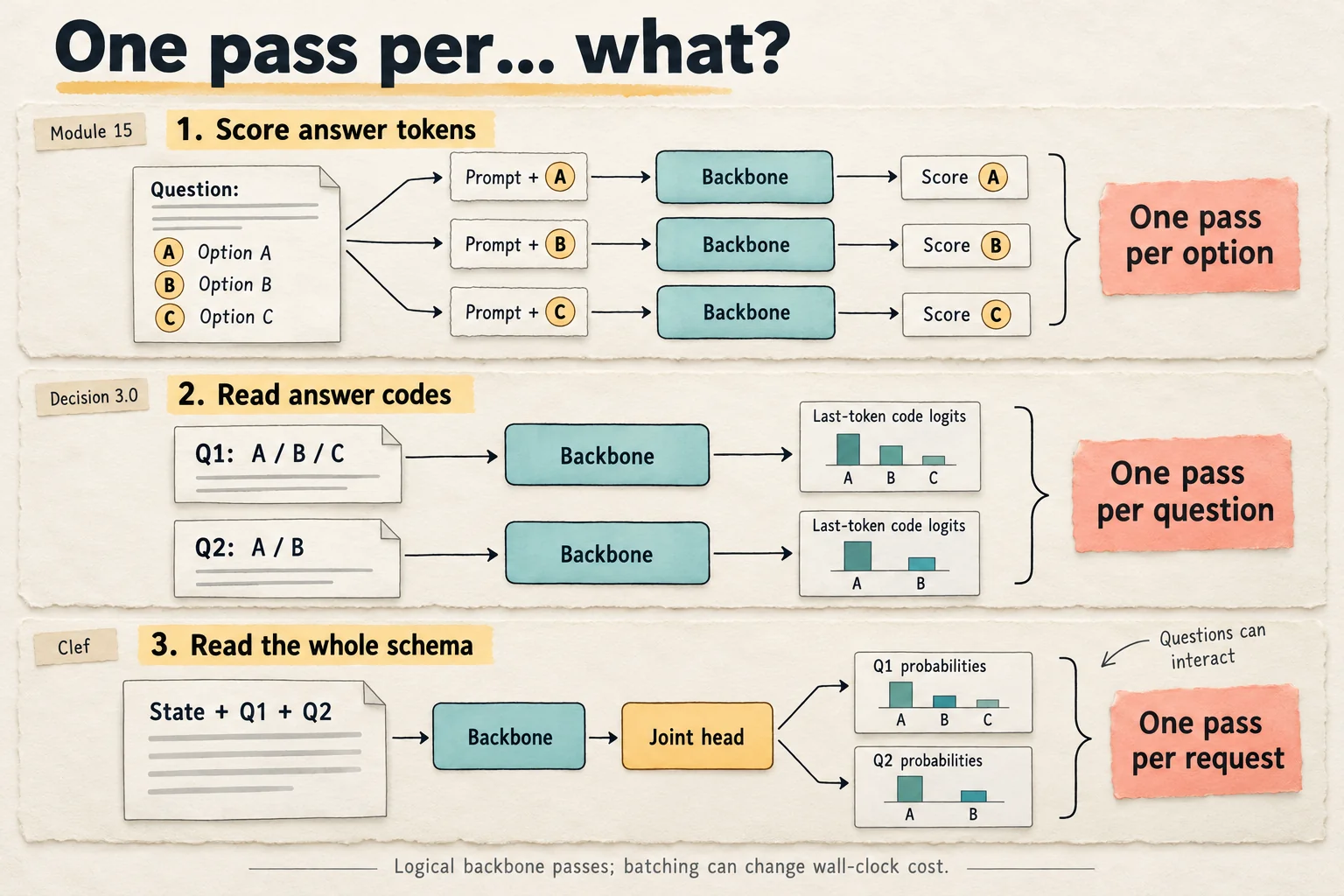 Ask what a pass is counted over. G2C interpretation: these logical paths summarize Module 15, Decision 3.0's documented readout, and Clef's code. Batching can change elapsed time; a shared endpoint does not make the architectures identical.
Not disclosed: Jev's architecture ("a new model architecture" and "a
parallel sampler," per TypeSafe), Nimble's, Tev1's, and Liquid d1's. Ollama's
Nimble example reports output_tokens: 4, so not every "decision model" is
strictly zero-output.
Inside Clef: reading the schema head from code
Clef is Qwen3.8-27B (a model with its own Brief) plus a head defined in a single PyTorch file. Clef-flash is the same head on Qwen3.5-9B. Here is what the code does, step by step.
Step 1: render the request as a prompt, and remember where things are
encode_record turns a request into a chat-formatted prompt:
<|im_start|>system
Read the complete state and schema. Decide every field jointly. Each answer
must be exactly one of that field's allowed options.<|im_end|>
<|im_start|>user
STATE:
{"ticket":"I was charged twice..."}

SCHEMA FIELDS:

FIELD 1
ID: team
TYPE: choice
INSTRUCTION: Which team should handle this ticket?        ← question span
ALLOWED OPTIONS:
OPTION 1: {"description":"Payments and refunds","option_id":"billing"}   ← option span
OPTION 2: {"description":"Bugs and integrations","option_id":"technical"} ← option span
END FIELD
...
<|im_end|>
<|im_start|>assistant
<think>

</think>

JOINT SCHEMA DECISIONS:
While building the prompt, it records the token span of every question's instruction and every option's text. Two details are worth noticing:
- The thinking block is empty. Qwen3.8 normally thinks before answering.
Clef writes an empty
<think></think>into the prompt, the same switch your Module 16 backend flips withthink=False. The model is told it has already finished thinking. - The state comes before the schema. G2C interpretation. The backbone
is causal, so the state's hidden states are computed without knowing what
will be asked. Only the question and option tokens can see the state. One
consequence: many different question sets about the same state could in
principle share one cached prefix. Clef's reference code doesn't do this
(
use_cache=False), and Cloudflare does not say whether its hosted service does.
Step 2: one backbone pass, then four kinds of vectors
The backbone runs once and returns its final hidden states, one
d-dimensional vector per token (d = 5120 for Clef). The language-model
output layer is never run over the sequence, though the head borrows its
weight rows. From those states the head builds:
| Vector | How it's computed | Course analogue |
|---|---|---|
| memory | every token's hidden state, projected to width 1024 | the K/V source for cross-attention |
| question | mean of hidden states over the instruction span | mean pooling |
| option context | mean of hidden states over each option's span | mean pooling |
| option lexical | mean of the output-embedding rows for the option's token ids | the unembedding matrix from Module 06 |
| global | the hidden state at the last token | the position whose logits you sample from |
Step 3: each option looks for evidence
Each option gets a query: a sum of projections of its context vector, its lexical vector, and its question's vector. Two evidence routing layers then let every option cross-attend to the memory, meaning every token of the prompt, followed by a feed-forward layer. In Module 07 terms, the options are the queries and the prompt is the keys and values. Each option goes looking for the parts of the state that support it.
Step 4: questions decide jointly
Each question becomes a field vector: its own projection, plus an
attention-weighted summary of its routed options, plus the global vector, plus
a learned embedding for its type (noul, choice, or score). The fields then
pass through four standard transformer decoder layers. Each layer has
self-attention among the fields, with no causal mask, so every question can
see every other, followed by cross-attention back to the prompt memory.
This is what "joint" means in Clef. If one question is "is this invoice a duplicate?" and another is "pay, hold, or reject?", the second can condition on the first inside the network, without the first being answered out loud.
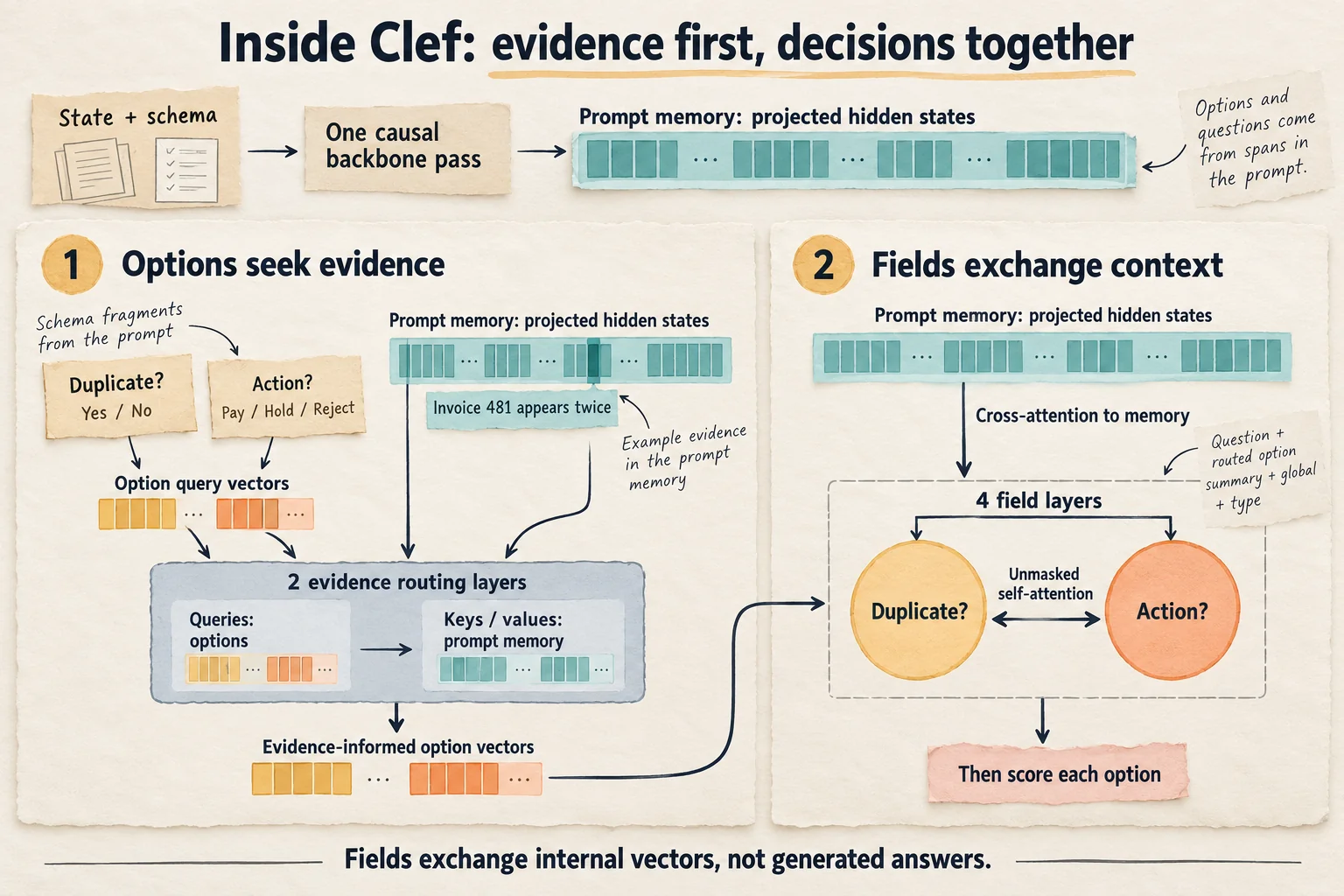 Options retrieve evidence; fields exchange context. Derived from Clef's released head: the two routing layers precede four field layers. The highlighted invoice fragment is illustrative, not a measured attention map. Projection and scorer details are omitted here; no field has to generate an answer for another field to use its internal state.
Step 5: score every option
Each option's final logit is the sum of two terms:
prior  = s_p · cos( option_lexical , normalize(question + global) )
joint  = s_j · cos( field , option ) + MLP([field, option, field⊙option, |field − option|])
logit  = prior + sigmoid(g) · joint                 # s_p, s_j, g are learned scalars
A softmax over each question's options gives the probabilities.
G2C interpretation. The prior term is a close cousin of next-token
logits. A language model's logit for a token is the dot product of the final
hidden state with that token's row of the output embedding. The prior takes
the cosine between a summary of the question and last position, and the
average output-embedding row of the option's tokens. Before any head training,
the backbone already "leans toward" some options through its vocabulary
geometry, and the prior keeps that signal. Cloudflare's blog calls it a
"lexical prior." The joint term is the trained correction, and the learned
gate decides how much to trust it.
One aside for course graduates: the head is built from
torch.nn.MultiheadAttention and torch.nn.TransformerDecoderLayer, the stock
modules that Modules 07–09 had you write by hand.
How big is the head?
Derived. Instantiating the head from the released joint_head_config.json
(width 1024, 2 routing layers, 4 field layers, 16 heads, feed-forward 4096)
and counting parameters:
| Component | Clef (d = 5120) |
Clef-flash (d = 4096) |
|---|---|---|
Six input projections, d → 1024 |
31.5M | 25.2M |
| Two evidence routing layers | 25.2M | 25.2M |
| Four field decoder layers | 67.2M | 67.2M |
| Scorer MLP and small terms | 4.2M | 4.2M |
| Head total | 128.1M | 121.8M |
| Share of the full model (27.36B / 9.41B) | 0.47% | 1.29% |
A head under half a percent of the model turns a chat model into a decision model. The rest of the adaptation is in the backbone's adapters.
Where the training went
Reported. Cloudflare kept the Qwen weights frozen and "jointly optimized
the routing head alongside rank-256 low-rank adapters." The released backbone
is described as "merged," so the adapter deltas have been folded into the
weights, exactly the merge() operation from Module 13B.
Derived. Rank 256 is large by Module 13B standards. On one of Qwen3.8-27B's
MLP matrices (5120 × 17,408, so 89.1M weights), a rank-256 adapter has
256 × (5120 + 17,408) = 5.77M parameters, 6.5% of the matrix. The
Module 13B example used rank 8 on a 960 × 960 projection, 1.7%. Not
disclosed: which matrices received adapters, so the total adapter size is
unknown.
Training for honest probabilities
Reported. Cloudflare's loss is "label-smoothed cross-entropy for valid schema outputs paired with a Brier loss to refine probability calibration." The training data is internal and synthetic, built to "permute field orders, prompts, and schema structures." Clef-omni uses the same recipe on a frozen Qwen3-Omni-30B-A3B backbone.
Both losses are things you know:
- Cross-entropy (probability primer) already rewards calibration, not just ranking: putting 99% on the right answer scores better than 51%. Label smoothing trains against a target that puts a little probability on every option, which discourages overconfidence.
- The Brier score is the squared error between the predicted distribution
and the one-hot truth:
Σ_k (p_k − y_k)². Like cross-entropy, it is lowest when predictions match true frequencies. Unlike cross-entropy, it doesn't blow up on a confident miss, so it's a gentler pull.
Reported. Both TypeSafe and Cloudflare also describe a reinforcement
learning stage called RLCD, "Reinforcement Learning for Calibrated
Decisions." Cloudflare says it gives partial credit when a score answer lands
on an adjacent level, rewards fully correct records, and applies a reference
penalty against drift. G2C interpretation. That last term plays the role of
the reference model in Module 14's DPO objective,
keeping the policy near where it started. Not disclosed: the reward
formulas, weights, and the algorithm itself, from either company.
Three different ways to measure "calibrated"
Module 15 taught you expected calibration error (ECE): bin predictions by confidence and compare each bin's average confidence with its accuracy. The System One literature is a good reminder that ECE is not enough on its own.
Reported, from the Typed Decisions benchmark card. A "Prior" baseline that ignores the input entirely and always predicts each question's training-set label frequencies "has the best ECE while knowing nothing." That's why the benchmark ranks models on KL divergence and Brier score instead.
G2C interpretation. A model that always says "47% billing" and is right 47% of the time is perfectly calibrated and completely useless. ECE checks that confidence matches accuracy on average within bins. It does not check that the model's probabilities change with the input. Brier score and log loss reward both, which is why they are the honest headline numbers.
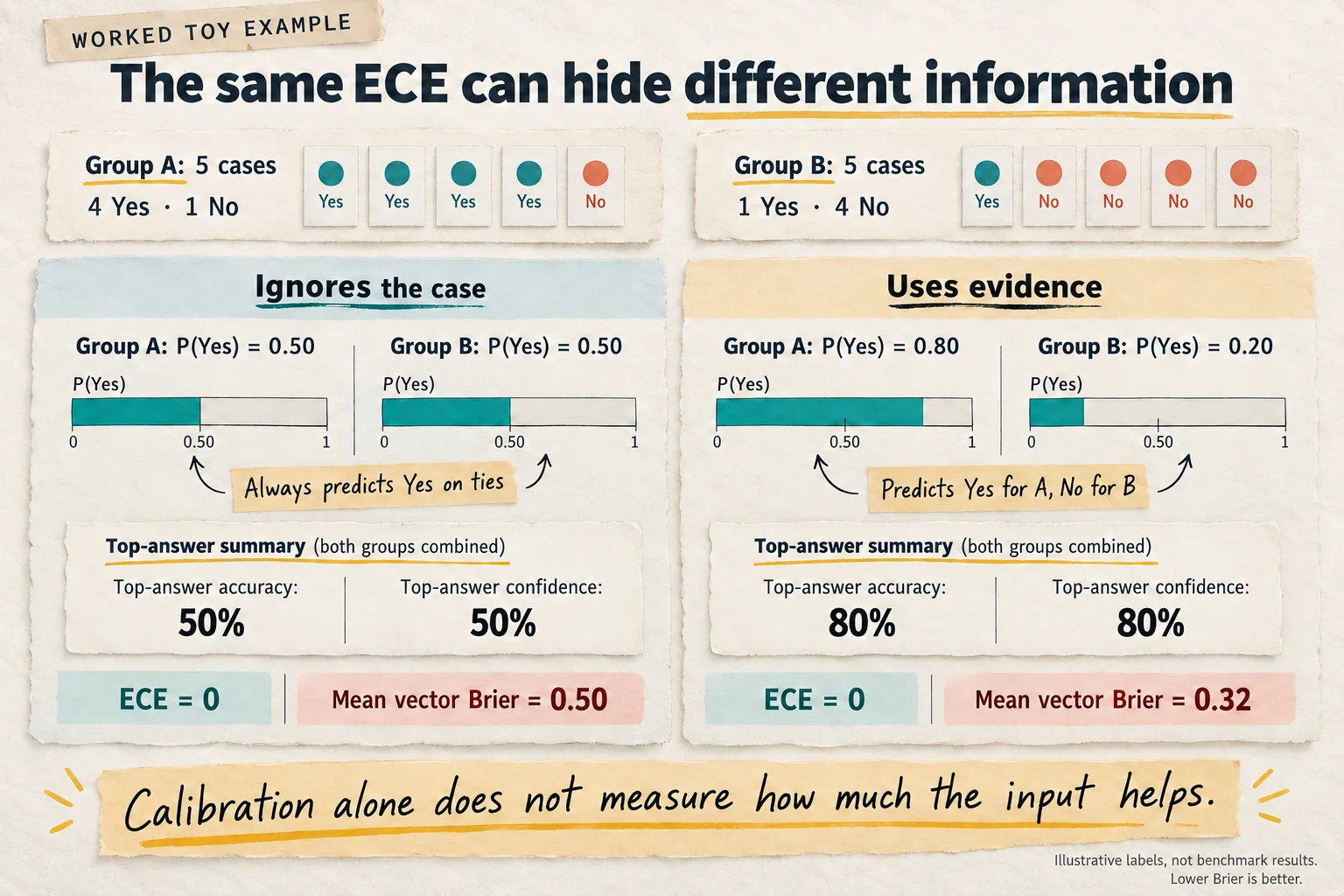 Calibration can agree while information differs. Derived, toy example: each group has five cases, with four Yes labels in A and one in B. Both predictors' top-answer confidence matches their accuracy, giving ECE zero; averaging the two-class squared errors gives vector Brier scores 0.50 and 0.32. The constant predictor chooses Yes on ties. These are worked numbers, not benchmark results.
The benchmark also shows the reverse failure. Reported. Jev's accuracy is near the benchmark's ceiling, and its confidence "is not badly calibrated." But it "puts nearly all its probability on one answer." So where the gold labels are genuinely uncertain, its KL divergence from the gold distribution is about 15 times worse than the leader's (1.442 versus 0.096). Good ECE, overconfident distributions.
Why it's fast and cheap
The efficiency argument is the Module 16 prefill/decode split taken to its limit.
G2C interpretation. Prefill processes all prompt tokens in parallel; it is compute-bound and uses the hardware well. Decode produces one token per sequential step and reads the full model weights each time; at small batch sizes it is memory-bound and slow. A System One model is all prefill. There is no decode loop, so there is no KV cache to keep, no sampling, and no per-token latency. A reasoning LLM that thinks for 500 tokens before writing its JSON pays for 500 sequential steps before the answer starts.
Derived. The head adds almost no compute. Its largest per-token cost is
projecting every hidden state from 5120 to 1024 dimensions, about
5120 × 1024 ≈ 5.2M multiply-adds per token, against roughly 25 billion for
the backbone: about 0.02%. Everything else in the head runs over a few dozen
option and field vectors, not over the whole prompt.
Billing follows the same logic. Reported prices per million input tokens, with output free or nonexistent: Clef-flash $0.038 (cut from $0.09 on October 9), Jev $0.042, Clairic $0.10. Derived. At Clef-flash's price, a 1,000-token request costs $0.000038, so a million of them cost $38.
Reported latencies, all measured by the vendors:
| Model | Median | p95 | Source |
|---|---|---|---|
| Clef-flash | 38.8 ms | 122.4 ms | Clef model card |
| Clef | 209.3 ms | 238.6 ms | Clef model card |
| Clef, after Oct 9 serving update, ~800-token input | 152 ms | 351 ms | Cloudflare blog |
| Jev | 524.1 ms | 536.0 ms | Clef model card |
| Nimble 9B, locally on an M5 Max | 91 ms per decision | — | Ollama blog |
Reported. The October 9 speedup came from "the serving infrastructure layer," mainly a move to SGLang, not from new weights. An independent test from Europe measured Clef at roughly 524–726 ms over the network (Flavio Copes), so treat the table as server time, not what your users will see.
There is also a context tradeoff. Reported. Cloudflare cut hosted Clef-flash's context from 64K to 24K tokens to reach the lower price, noting that only 0.24% of requests exceeded 24K. The open weights are unchanged and were trained for 256K. A prefill-only model's cost scales with input length, so input length is what gets priced and capped.
Cascades: deciding before you write
Reported. Cloudflare's Clairic post describes a three-stage claims-processing pipeline: Clairic extracts typed values from the claim, Clef decides from those values, and an LLM (GLM-5.3) writes only the customer-facing text. Against an all-LLM version, Cloudflare reports 19.3 s versus 61.7 s per claim and $6,032 versus $11,740 per million claims. Derived. That is 3.2× faster and 49% cheaper. G2C interpretation. This is the Module 19 agent loop with its branching decisions handed to a cheaper, typed component, and generation kept for the one step that actually needs prose.
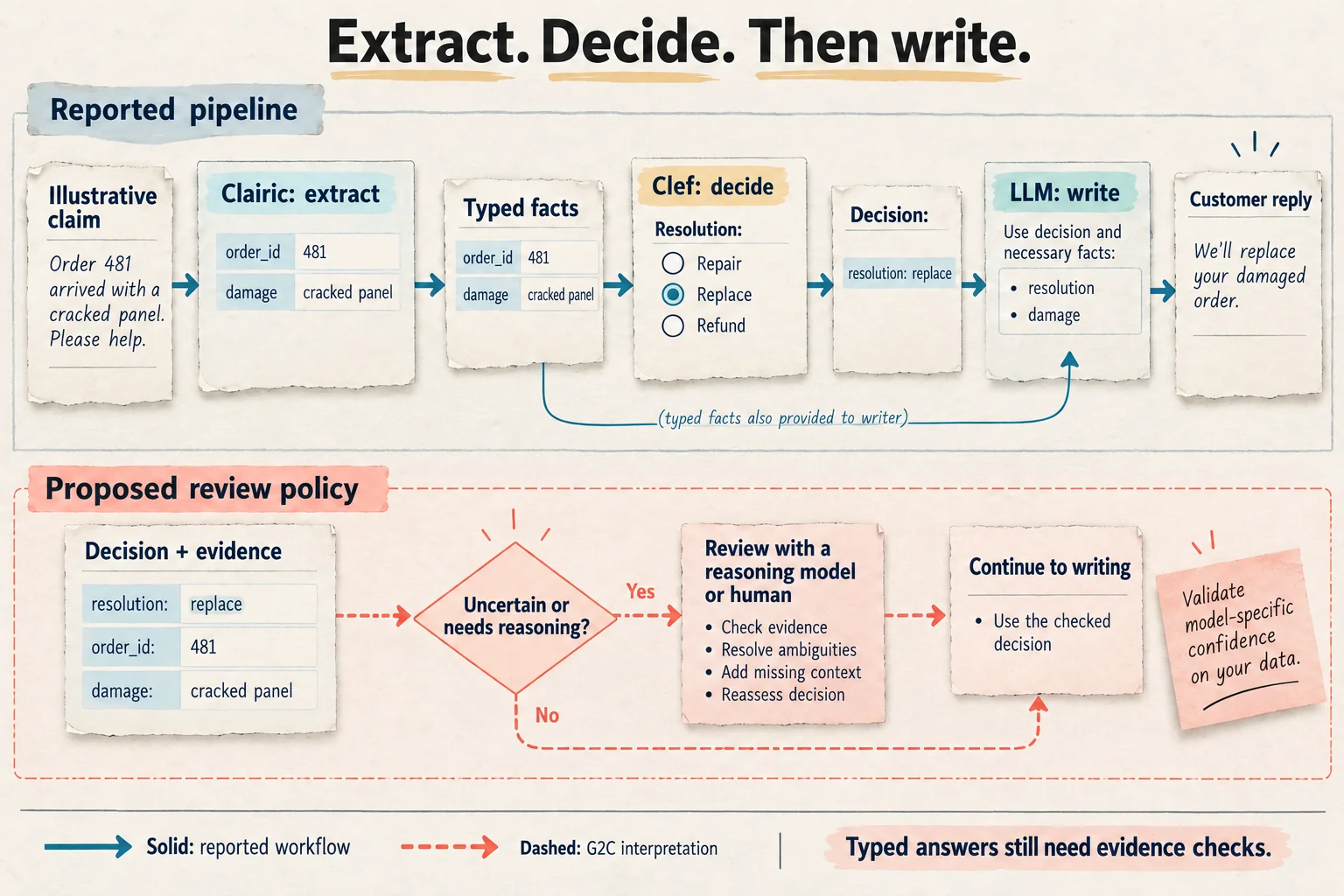 Give each stage the work its output type supports. Reported: Cloudflare's workflow extracts facts, decides, then writes the reply. The claim and field values shown here are illustrative. G2C interpretation: the separate dashed review policy is a proposed extension; its confidence thresholds need validation on the chosen model and your own data.
Clairic: from choosing to extracting
Decision models choose among options you list. Clairic, released today, returns values you can't list in advance.
Reported, from Cloudflare's post and the Clairic API docs:
- Field types: text, numbers (with
decimalsand units), dates and durations, lists,estimate(a distribution over a declared[min, max]range on astepgrid, linear or log scale), andforecast(one estimate per future step). - Text answers are spans of the input, with character offsets. Clairic never writes new text; it points at text that's already there.
- Every scalar answer has a null probability and a confidence. Estimates
return a median, an 80% interval (
p10top90), and optionally all 99 percentiles. - Fields are answered in parallel passes of up to 8,192 tokens, each seeing the full input, when they don't all fit in one.
- Context is 65,536 tokens; up to four images. It is a hosted preview, and Cloudflare says it intends to release open weights "soon."
Not disclosed: the base model, the head, and how values are produced. G2C interpretation. The API strongly suggests two classic mechanisms. Text spans with start and end offsets look like the span-pointer heads used for reading comprehension: score every token as a possible start and end. Estimates on a declared grid of steps look like classification over bins, which gives a discrete distribution from which percentiles can be read directly. If so, Clairic is still a classifier underneath, choosing positions and bins rather than named options. This is inference from the interface, not something Cloudflare has said.
Cloudflare is candid about limits. Reported: answers are "well formed, not necessarily correct"; multi-step arithmetic and aggregation are weak ("let code do the math"); and intervals "are trained to be calibrated and are on most held-out sets, but they can run narrow on unfamiliar data." The post's forecasting demo predicted 21 days of US airport checkpoint traffic, and 17 of 21 actual values fell inside the 80% interval.
Derived. 17 of 21 is 81%, which looks perfect for an 80% interval. But
with 21 days and a true 80% coverage rate, the expected count is 16.8 with a
standard deviation of √(21 × 0.8 × 0.2) ≈ 1.8. Anything from about 15 to 19 is
unremarkable. The demo is consistent with good calibration, but too small to
show it.
Reading the evidence
Cloudflare's Decision Index
The Clef model card reports 41 benchmarks from Cloudflare's own run of the Decision Index suite (version 0.2.1), comparing Clef, Clef-flash, Jev, and three other decision models.
Derived, counting the best score in each row: Clef-flash is best on 16, Clef on 11, Jev on 11, and the other three models on 3 between them. Three patterns stand out:
- Jev wins the reasoning-heavy rows by a lot. GPQA Diamond: Jev 78.3, Clef 48.0, Clef-flash 51.0. MMLU-Pro: 82.7 vs 65.9 and 65.3. BBH: 92.9 vs 73.7 and 68.9. G2C interpretation. These are exactly the tasks where a generating model would think first. Whatever Jev does differently, and it isn't disclosed, it holds up better when the decision requires several steps of reasoning. The pattern isn't perfectly clean: Clef narrowly beats Jev on GSM8K (80.8 vs 79.9).
- The smaller model often beats the larger one. Clef-flash wins more rows than Clef, but it also collapses on some: CLINC150+OOS 66.8 vs 97.4, RAGTruth 35.6 vs 79.4. Not disclosed: why.
- The fastest model is not usable. Laya has a 5.8 ms median latency and far lower scores than the others on nearly every row. Latency tables mean little without the quality column beside them.
An independent benchmark
Typed Decisions is a community benchmark that states it is not affiliated with TypeSafe. It has 400 test cases across four business workflows, each with five questions. Its card is a model of how to report this kind of evaluation:
- The gold labels come from a teacher model. Reported. Gold is "the mean of three samples from a teacher of roughly 4B-class capability, so a score measures agreement with that teacher, not correctness." A fresh teacher sample agrees with the gold 73.5% of the time, which sets a practical ceiling. Scores well above it "mean a model is learning the teacher's quirks."
- Zero-shot and fine-tuned models are kept apart. A model fitted to these four workflows "cannot answer anything else," so comparing it with a general model measures "the price of generality, not a quality ranking."
- Request shape matters. Reported. In a third-party run, Jev's yes/no accuracy was 0.843 with one question per request and 0.788 when asked alongside the other four. Answering jointly is a design choice with costs, not a free win.
Reported. Clef's model card lists a run on this benchmark: accuracy 0.7275, ECE 0.025, Brier 0.103. Clef-flash: 0.710, ECE 0.016, Brier 0.111. Those accuracies sit right at the teacher-agreement ceiling. The benchmark card warns that "ECE in particular is computed differently by different submitters," so compare Brier scores across rows, not ECE.
Where informed readers will push back
These are this Brief's reading of the category's weak points. All are G2C interpretation.
"Can't hallucinate" means "can't produce the wrong type." TypeSafe says Jev "can't hallucinate" and that type errors are "mathematically impossible." The second claim is true by construction: if the only outputs are probabilities over listed options, there is nothing malformed to emit. The first claim doesn't follow from the second. Module 18 put it in one line: the grammar carries the syntax; the model carries the semantics. A decision model can confidently choose the wrong option, and Cloudflare's own Clairic post says its answers are "well formed, not necessarily correct." A related subtlety: a decision model can only decline to answer if the schema offers a way. Clef has no built-in abstain option. If "none of the above" isn't in the list, the probabilities still sum to one across the options that are. Clairic's null probability is a step toward fixing that.
One pass can't deliberate. The GPQA and BBH gaps are what you'd predict from a model that can't write down intermediate steps. The System One framing admits this, and the right use is clear from the cascade example: route the easy, high-volume decisions to a System One model, and send low-confidence or multi-step cases to a model that can think. That only works if the confidence scores are trustworthy on your data.
Calibration is measured where the training data looks like the test data. Clef was trained on synthetic schemas, and the main independent benchmark's labels come from a small teacher model. Clairic's post concedes intervals "run narrow on unfamiliar data." Calibration that holds on held-out data from the same distribution can fail under distribution shift, which is when a routing threshold matters most. Module 15's reliability diagram on your own labeled sample is the check.
A shared API is not shared semantics. The request and response shapes
match across vendors, but the numbers inside them don't always mean the same
thing. In Clef's code, confidence is the top option's probability. In
Ollama's Nimble example, the team answer has top probability 0.985 and
confidence 0.922, and the urgency answer has top probability 0.429 and
confidence 0.046. Not disclosed: what Nimble's confidence measures. Code
that swaps models behind the same endpoint and keeps the same confidence
threshold could change its behavior silently.
Most of the numbers are self-reported. Latencies, Decision Index scores, and pipeline savings all come from the companies selling the models. The independent benchmark is young, small, and teacher-labeled, and the one independent latency test found network time dominating.
The laptop boundary, and what you can check yourself
You cannot train Clef. But this is the most laptop-friendly category a Brief has covered so far, because the course's own production backend already speaks the API.
- Run a decision model in Ollama. Reported by Ollama's library pages:
Ollama 0.35 and later serve
/v1/systemonelocally.tev1:0.8bis about 0.8 GB,tev1(4B) about 4.4 GB, andclef-flashabout 11 GB. The 0.8B model fits on any course machine. Send the same ticket schema to it and to your ProdLM with Module 18's constrained JSON, and compare latency, answers, and whether the probabilities move when you change the ticket. - Measure calibration with your own code. The Typed Decisions test split
is 400 cases with full gold distributions, loadable with
datasets. Your Module 15expected_calibration_errorworks on the outputs as-is. Add a Brier score next to it and compare both against the input-ignoring Prior baseline to see the ECE trap for yourself. - Build the smallest version of the mechanism on BaseLM. Freeze the backbone, read its final hidden states, and train a small head with cross-entropy plus Brier. Here is a sketch, not an assignment:
backbone = model.inner.model                     # BaseLM's transformer, without the LM head
backbone.requires_grad_(False)                   # frozen, as in Clef
head = torch.nn.Linear(960, n_options)           # SmolLM-360M's hidden size is 960

hidden = backbone(input_ids=ids, attention_mask=mask).last_hidden_state
last = hidden[torch.arange(len(ids)), mask.sum(1) - 1]    # last real token (right padding)
logits = head(last)
p = logits.softmax(-1)
loss = F.cross_entropy(logits, y, label_smoothing=0.1) \
     + ((p - F.one_hot(y, n_options)) ** 2).sum(-1).mean()  # Brier term
This is a plain classifier: its options are fixed rows of head. The step
from here to Clef is making the options input: put them in the prompt,
pool each option's span as in Step 2, and score option vectors against a
question vector instead of using fixed rows.
Reported by the Typed Decisions leaderboard: one community entry put
Clef's open head on a LoRA-tuned Qwen3.5-4B, and tiny fine-tuned encoders
(a 22M MiniLM, a 150M mmBERT) score respectably on four fixed workflows. The
gap between those and the general models is the price of generality.
None of this is required.
Coverage map
| Mechanism | Label | Where to anchor it |
|---|---|---|
| Classification from hidden states; softmax over classes | Built in g2c | Module 03 |
| Scoring options by log-probability (closed-set eval) | Built in g2c | Module 15 |
| ECE and reliability diagrams | Built in g2c | Module 15 |
| Cross-entropy as a calibration-aware loss | Built in g2c | Probability primer, Module 06 |
| Frozen backbone, LoRA, merging | Built in g2c | Module 13B |
| Prefill vs decode cost; turning thinking off | Built in g2c | Module 16 |
| Cross-attention (options querying the prompt) | Conceptual bridge | Module 07 builds self-attention; cross-attention swaps the K/V source |
| Constrained JSON as the generative alternative | Built in g2c | Module 18 |
| Synthetic training data with permuted schemas | Conceptual bridge | Module 16B |
| Reference penalty in RL fine-tuning | Conceptual bridge | Module 14, Beyond: RL |
| Routing decisions inside an agent pipeline | Conceptual bridge | Module 19 |
| Brier score, label smoothing | Not yet covered | Short; this Brief's training section has the definitions |
| Joint schema head (options as input, scored jointly) | Not yet covered | This Brief's Clef walkthrough |
| Span-pointer extraction; distributions over value bins | Not yet covered | — |
| Bidirectional attention in a decoder backbone | Not yet covered | — |
G2C interpretation. By the Beyond-module test, recurrence across independent groups and a useful laptop build, this category is a strong candidate: at least six organizations shipped implementations within five weeks, and a schema head on a frozen BaseLM would fit in a laptop session. That is evidence for the decision, not a commitment.
A reading route
- Ollama's announcement. The shortest complete picture of the API, with a worked request and response.
- Cloudflare's Clef post,
then
joint_schema_model.pyalongside this Brief's walkthrough. The code answers most of what the post leaves vague. - The Typed Decisions card, especially "Reading a score." The clearest writing in this area about what these numbers do and don't mean.
- Cloudflare's Clairic post. The extension from choices to values, and the cascade argument.
- TypeSafe's launch post. The origin and the framing. Read its demo caveats; they are more candid than the headline numbers.
- The vLLM Decision 3.0 recipe, for a second architecture: per-question passes and bidirectional attention.
After this Brief, you should be able to
- Explain what a System One model returns and why it needs no decode loop.
- Describe the three question types, and compute a
scoreanswer from its level probabilities. - Compare three ways of reading a decision out of a language model by their passes per request and whether questions can see each other.
- Walk through Clef's head: spans, pooled vectors, evidence routing, joint field decoding, and the prior-plus-joint score.
- Explain why a model can have excellent ECE and be useless, and which metrics catch that.
- Say precisely what "can't hallucinate" does and doesn't guarantee, using Module 18's syntax/semantics distinction.
- Decide when a task belongs to a System One model, and when it needs a model that can think first.