Module 10 — Milestone: TinyLLM
Question this module answers: Can I build a language model using the tools we learned?
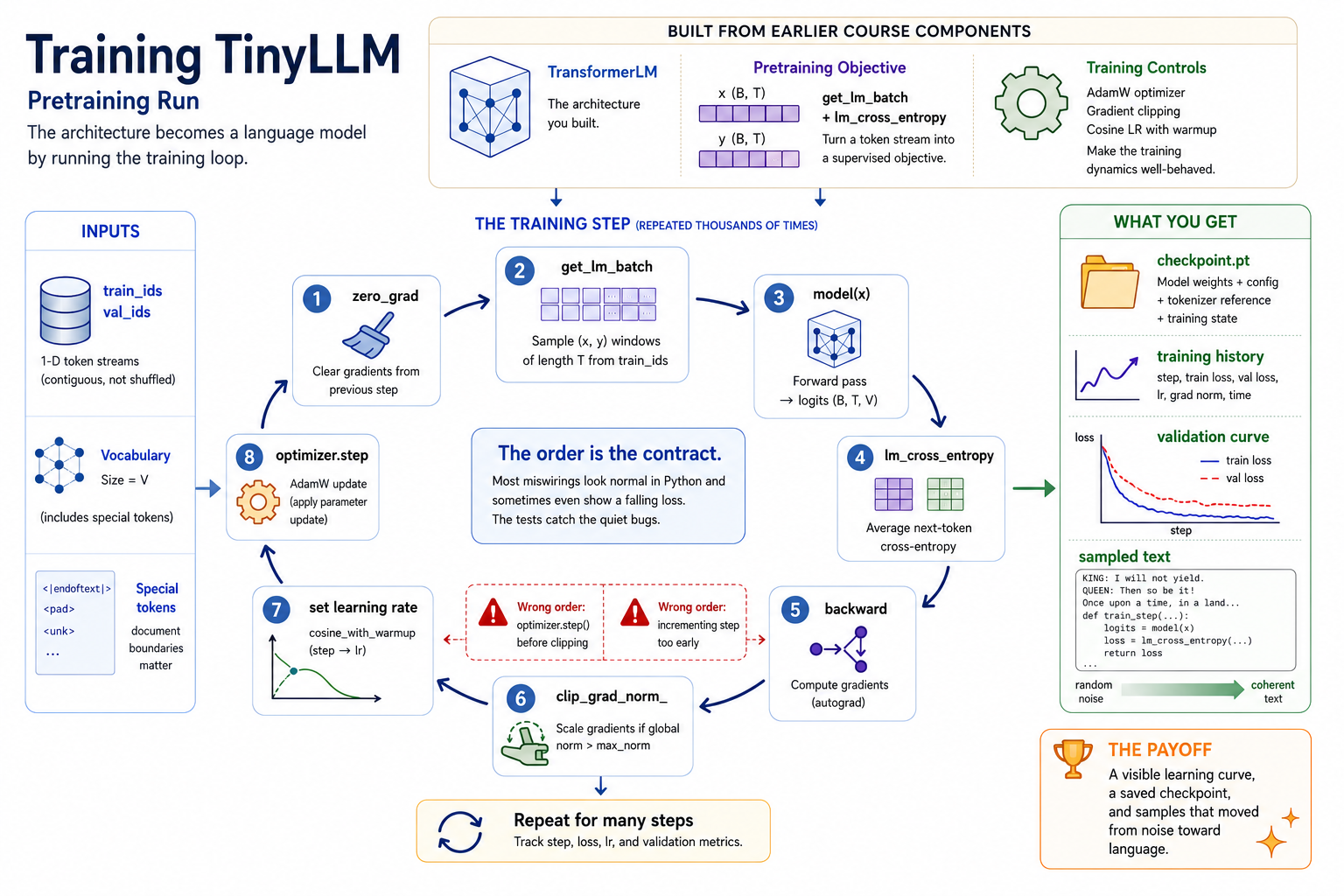
This is the payoff week for the transformer stretch. Module 09 built the architecture. Module 09B turned a token stream into a supervised objective. Module 03B made the training controls legible. Module 10 wires those pieces together and produces the first trained checkpoint. Module 11 then teaches it to speak, closing out Part I.
Before you start
- Review
- 03b-training (AdamW, clipping, lr schedule)
- 09b-pretraining (batching, cross-entropy)
- Finish
g2c/transformer-blockfrom 09-transformer-blockg2c/pretrainingfrom 09b-pretrainingg2c/trainingfrom 03b-training.- The trained tokenizers from 04-tokenizer notebook (optional;
datasets.shwill generate if missing)
- Run
./datasets.shto pre-generate the datasets used for the large training runs.
Where this fits in
The transformer is finally complete, but an untrained transformer is just a random function. Module 10 makes it a language model by repeating one training step thousands of times:
train_ids
  -> get_lm_batch              # Module 09B
  -> model(x)                  # Module 09
  -> lm_cross_entropy          # Module 09B
  -> backward                  # PyTorch autograd over your modules
  -> clip_grad_norm_           # Module 03B
  -> cosine_with_warmup        # Module 03B
  -> optimizer.step            # Module 03 or 03B
  -> history + validation
The new concept is not a new layer. It is orchestration. The course stack now has enough pieces that the core engineering problem is putting them in the right order, tracking the run, and using the resulting curve and samples to decide whether training is healthy.
The big idea
The trainer is glue, but load-bearing glue
Trainer.train_step is short, but the order is part of the contract:
optimizer.zero_grad()- sample
(x, y)withget_lm_batch - move
xandyto the trainer device logits = model(x)loss = lm_cross_entropy(logits, y)loss.backward()- clip gradients if requested
- set the scheduled learning rate
optimizer.step()- increment
self.step
Two lines are easy to swap accidentally:
WRONG: optimizer.step() before clipping
WRONG: incrementing self.step before computing/logging the lr for this step
Those bugs often produce a run that still appears to train. The tests pin down the step counter, learning-rate assignment, clipping behavior, evaluation mode, and end-to-end loss decrease.
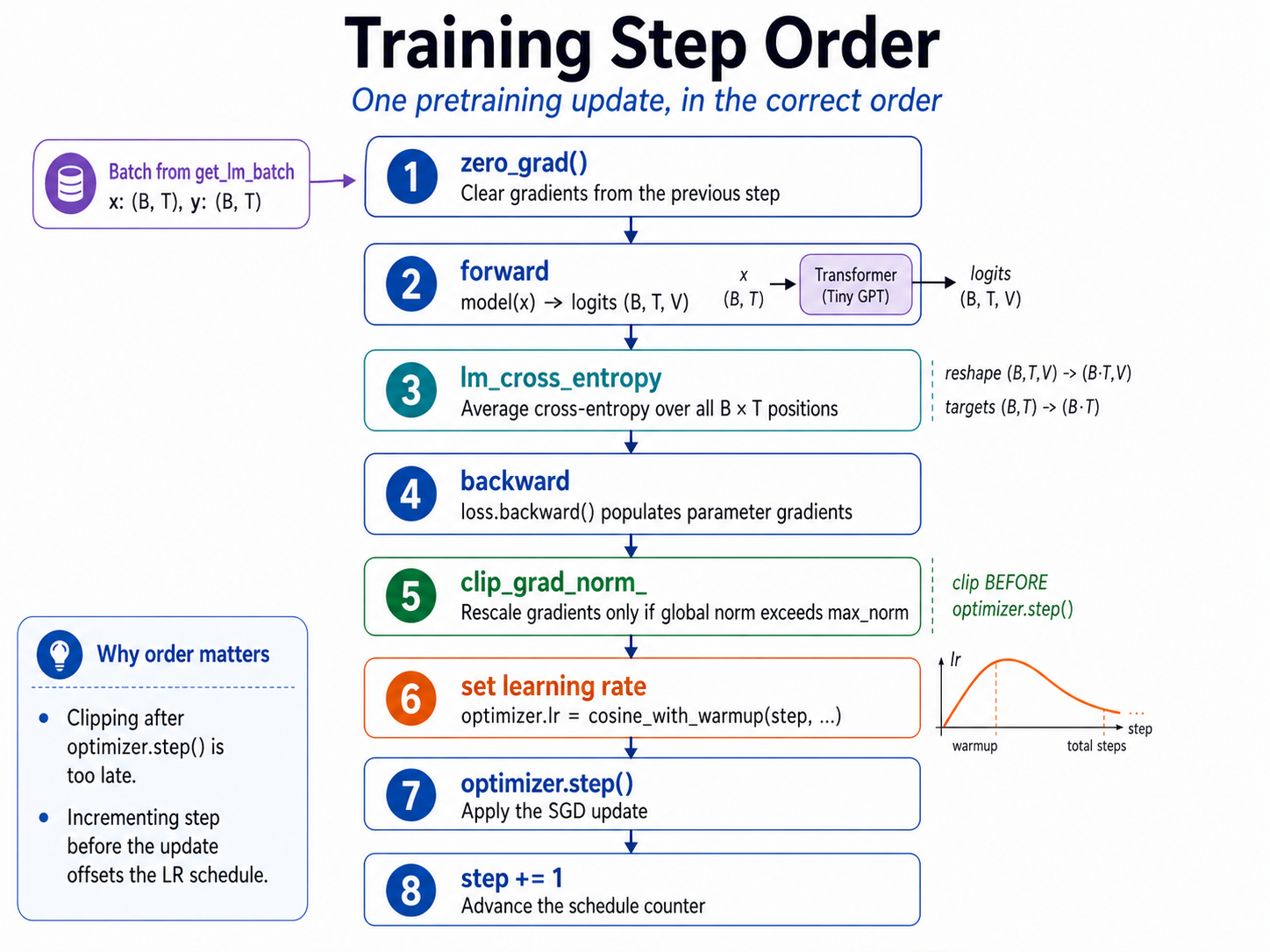 The order is the lesson. Most miswirings produce normal-looking Python and sometimes even a falling loss curve. The trainer tests are designed to catch the quiet versions of those mistakes.
The artifact matters
Module 10 should feel different from earlier modules because it produces something you can inspect qualitatively:
- a checkpoint,
- a training history,
- a validation curve,
- and sampled text from the model.
The first samples will be rough. That is expected. The milestone is not "a useful assistant." The milestone is "a model with a visible learning curve and output that moved from random tokens toward language-like structure because of code you wrote."
Validation is part of the loop
Training loss alone can lie. The trainer periodically evaluates on held-out val_ids:
train loss down, val loss down     -> healthy
train loss down, val loss flat/up  -> memorization or data mismatch
both flat near log(V)              -> training is not really moving
loss spikes / NaNs                 -> lr too high, clipping missing, bug
The Module 03B curve-reading habits now apply to a real transformer.
Concepts to internalize
- Pretraining is repeated next-token prediction over a corpus.
- The trainer composes earlier modules. It should feel like assembly, not new math.
- Ordering matters. The training step has a contract.
- Validation loss is the primary health metric. Samples are useful, but noisy.
log(V)is a step-0 sanity check, not a goal. The run needs to fall below it.- Tiny models learn form before meaning. Punctuation, word fragments, and local phrase shape appear before global coherence.
- Gradient accumulation is linearity, exploited.
.gradsums contributions — the same rule your Module 01 engine implements — so K micro-batches ofB/K, each with its loss divided by K, reproduce one batch ofBexactly, while activation memory only ever holds one micro-batch. Two rules carry all the bugs: divide each micro-loss by K (or you've multiplied the learning rate by K), and clip once after the last micro-batch (clipping is nonlinear; it doesn't commute with the sum). It's a memory lever, not a speed lever.
What you'll build
Package: g2c/pretraining/
class Trainer:
    def __init__(
        self,
        model,
        *,
        batch_size: int,
        context_length: int,
        max_steps: int,
        max_lr: float,
        min_lr: float = 0.0,
        warmup_steps: int = 0,
        weight_decay: float = 0.0,
        grad_clip: float | None = None,
        eval_every: int = 100,
        eval_iters: int = 20,
        log_every: int = 10,
        generator: torch.Generator | None = None,
        device: str | torch.device = "auto",
        optimizer: str = "sgd",
    ): ...                                                       # implemented

    def lr(self, step: int | None = None) -> float: ...          # implemented
    def train_step(self, train_ids: torch.Tensor) -> dict: ...   # SCAFFOLDED
    def evaluate(self, eval_ids: torch.Tensor) -> float: ...     # implemented
    def train(self, train_ids, val_ids=None) -> dict: ...        # implemented
Trainer.train_step is the one scaffolded method. Construction, lr, evaluate, and train are implemented so the student can focus on the one load-bearing step. The trainer pulls in g2c/pretraining/data.py and loss.py (Module 09B), g2c/training/ (Module 03B), and g2c.transformer.TransformerLM (Module 09).
How to run the tests
Tests live in tests/test_pretraining.py. Initial state: 9 passed, 19 failed.
When debugging, run prerequisite tests first to localize failures:
source .venv/bin/activate
pytest tests/test_training.py -x
pytest tests/test_pretraining_setup.py -x
pytest tests/test_transformer.py -x
Then run Module 10:
Exercises
To launch the exercise notebook run:
If at any point you want to archive the work in your current notebook and restart fresh:
Each exercise has Question: / Answer: cells inside the notebook. If you'd like a hint instead of a grade, write the request in the answer string and ask a coding agent for help. Blank answers are skipped rather than counted wrong.
- Implement the trainer step. Fill in
Trainer.train_stepand run the focused tests. - Prepare the first corpus. Load tokenizer/data artifacts, split tokens, and inspect batch shapes.
- Train ShakespeareLM. Run the small transformer baseline and plot train/validation loss.
- Sample from milestones. Compare text before and after training.
- Prove gradient accumulation. Verify that K accumulated micro-batches equal one big batch to float precision, then break it both ways on purpose.
- Run StoryLM scale-ups. Try the checkpointed TinyStories paths your machine can handle.
- Diagnose the run. Record loss, perplexity, sample quality, and the next experiment.
Pitfalls to expect
- Forgetting
zero_grad. PyTorch accumulates gradients. Without clearing them, training quickly becomes unstable. - Clipping after
optimizer.step. The optimizer already consumed the unclipped gradients. - Not moving batches to the model device. The corpus can stay on CPU, but sampled
xandymust be on the same device as the model. - Evaluation with grads enabled. It wastes memory and can make long validation passes fail.
- Treating samples as the only metric. Samples are high-variance. Use validation loss to judge training health.
- Scaling too many knobs at once. If a larger run improves or regresses, you need to know which change caused it.
- Accumulating gradients without the
/K, or clipping per micro-batch. The first silently multiplies your learning rate by K; the second clips a different vector than the one big-batch training would clip. Exercise 5 plants both bugs so you see each signature once.
M-series notes
This is the first module where MPS should be the default. Use CPU only for debugging tiny tests.
Practical starting points:
- 1M params, 2000 steps, TinyShakespeare: minutes on MPS. Memory usage minimal.
- 5M params on TinyStories: hours depending on data slice, context length, and Mac.
- 30M params on TinyStories: a longer experiment; overnight to a couple of days for the full run. But the notebook lets you stop early, inspect performance, and save the model if it looks good enough.
- 30M params on g2c: same story as 30M TinyStories. The full run is longer, but tokens/s should be about the same. Stop early when performance is acceptable.
- If memory fails: halve
batch_size— and double your gradient-accumulation steps to keep the effective batch, or you've quietly changed the experiment (Exercise 5 proves the equivalence). If that's not enough, reducecontext_length. The(B, T, V)logits tensor is often the largest activation. - macOS Activity Monitor. GPU usage should stay close to 100% and memory pressure green or yellow.
- Avoid running on battery. macOS heavily throttles long-running GPU processes on battery.
- If the scale-ups are out of reach. Training your own ladder is this module's deliverable, but Modules 12+ don't have to wait on it:
./checkpoints.shfetches the course's reference StoryLM checkpoints (Module 12 explains the trade). Whatever your machine can train is still worth saving — the reference manifests record the course runs' final losses, so you can compare your run against them.
Reading
Primary:
- Karpathy, nanoGPT, especially the
Trainer-equivalent training loop. - Karpathy, "Let's reproduce GPT-2 (124M)", the end-to-end pretraining sections.
Secondary:
- Kaplan et al., "Scaling Laws for Neural Language Models" (2020).
- Hoffmann et al., "Training Compute-Optimal Large Language Models" (2022).
Deliverable checklist
- All tests in
tests/test_pretraining.pypass. - Notebook:
notebooks/solutions/10-tinyllm.ipynb. - A tiny trained checkpoint is saved locally.
- StoryLM scale-up checkpoints can be interrupted, sampled, and resumed.
- The gradient-accumulation equivalence check passes, and you can state the two rules from memory.
- Training history includes train loss, validation loss, learning rate, and gradient norm.
- You can explain the full trainer step order without notes.
- You can compare the initial sample and trained sample and identify what improved.