Syllabus — From Gradients to ChatGPT¶
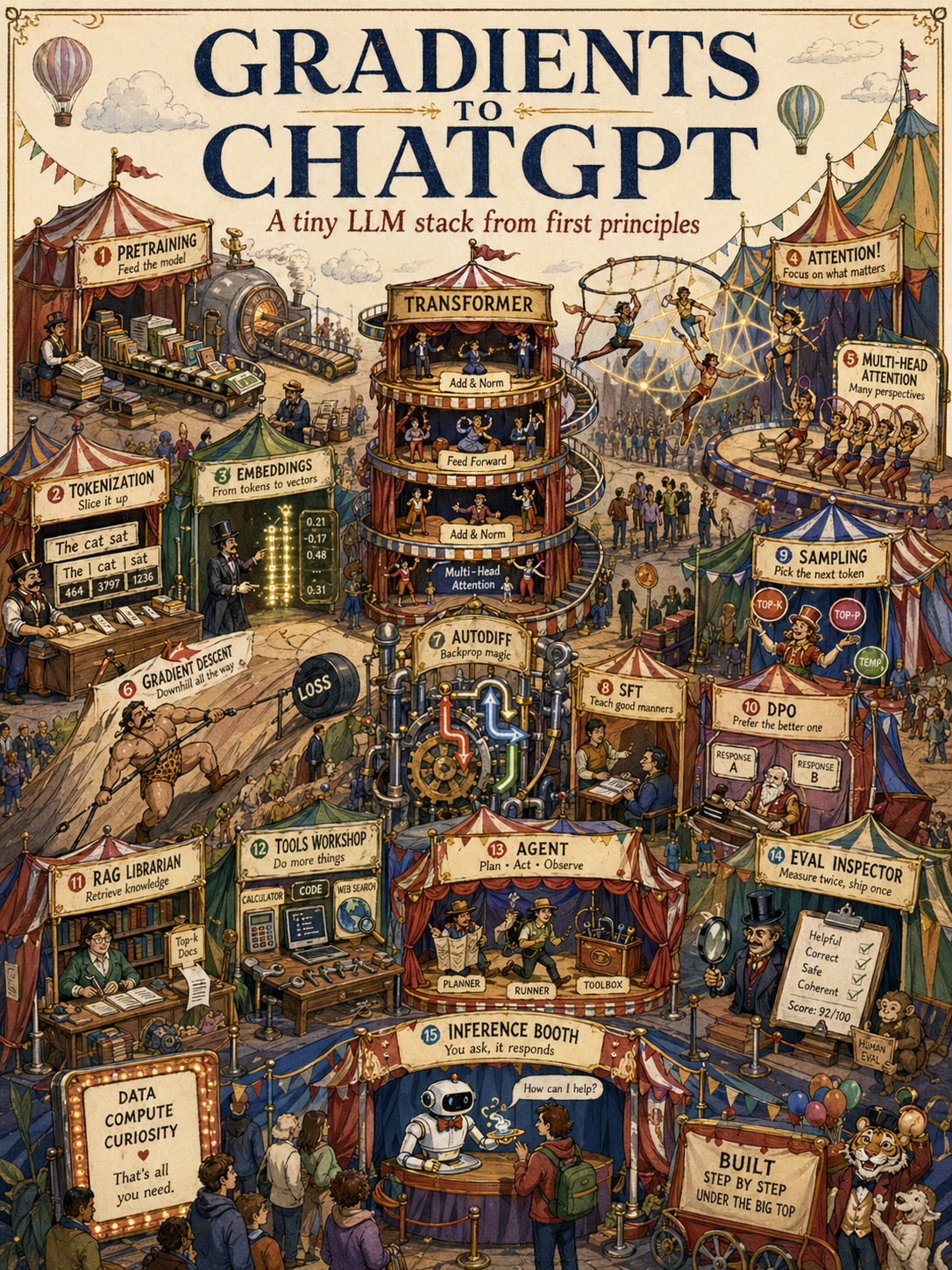
A self-study course, preceded by a fast prerequisite review, building a tiny LLM stack from scalar autograd up through a working chat assistant. Each week builds on the previous one. The codebase grows in g2c/ as a single Python package; later modules import earlier ones.
The course comes in two parts, and the first one is a finish line, not a checkpoint:
- Part I — From gradients to a language model (Modules 00–11). Build the thing itself: autodiff, tensors, a neural net, a tokenizer, embeddings, attention, the transformer, pretraining, and decoding. You end with a language model you wrote every layer of, generating readable text.
- Part II — From a language model to ChatGPT (Modules 12–20). Build the system around a model: scaling, instruction tuning, preference tuning, evaluation, fast inference, retrieval, tools, agent loops, and a chat assistant.
Finishing Part I is a real accomplishment on its own — you will have built a working language model from scalar derivatives up. Part II is a different subject, not a harder one: it is about the machinery that turns a model into something people can use.
How to read this syllabus¶
Each week has the same structure:
- Question — the one-sentence motivation, in the style of the brainstorm.
- Goal — what you'll have built by the end.
- Concepts — the ideas to internalize.
- Build — what code lands in
g2c/<topic>/. - Exercises — concrete tasks to do.
- Deliverable — what "done" looks like.
- Reading — primary references.
- M-series notes — practical compute notes when relevant.
A "week" is one week of effort at the level of a rigorous elite-college course. Real calendar time will vary.
How long a module actually takes¶
Three different clocks matter, and only two of them are predictable.
Reading is short. Lesson pages run 8–28 minutes of reading; the longest are Modules 16 and 19. Run python scripts/module_word_counts.py --reading-time for the current per-module numbers.
Machine time is documented. Most modules cost nothing beyond a few seconds of compute. The exceptions are worth planning around: Module 10 trains a model (minutes for the small artifacts, multi-hour or overnight for the largest), and Module 12 compares several trained checkpoints, so it inherits whatever you did in Module 10. One-time downloads land at Modules 04, 05, 13, and 16. Course Tracks and Artifacts has the full table, and every long run checkpoints so you can interrupt, sample, and resume.
Your time on the implementation and exercises is the big one, and we deliberately don't publish a number for it. It varies enormously by background, and the honest signals we have measure volume rather than difficulty — Module 07 asks you to implement only two functions, but self-attention is one of the hardest ideas in the course, so any estimate derived from counting scaffolds would tell you the opposite of the truth. We would rather say nothing than publish a figure that makes you feel slow for taking the time the material actually deserves.
If you want to help fix that: the stuck report form asks roughly how long you'd been working before you got stuck. Enough of those and this section can be replaced with real data instead of a disclaimer.
Module 0 is the exception: it is a fast review, not a full course week. Use it to put the necessary math, ML, PyTorch, and repo mechanics back in working memory before starting Module 1.
Prerequisites¶
- Comfortable Python and software engineering hygiene (testing, packaging, debugging).
- Calculus through partial derivatives and the chain rule.
- Linear algebra: matrix-vector products, inner products, basis transformations.
- Classical ML literacy (regression, classification, train/val/test, overfitting).
- Limited prior deep-learning experience is expected — DL concepts are introduced as new material.
If these are familiar but rusty, start with Module 0: Prerequisite review. If several are new, treat Module 0 as a map for a longer fundamentals pass before beginning the course.
Stack¶
- Python 3.11+
- PyTorch with the MPS backend (primary)
- Jupyter for exploration (
notebooks/) - Ollama for serving pretrained open models in the capstone
Ground rules¶
- From-scratch through the architecture (Part I, weeks 1–11). When the topic of the week is the thing — autograd, attention, the transformer block — build it. Don't import a high-level abstraction that does the work for you.
- Use a pretrained base model through behavior shaping (weeks 12–15). Scaling experiments, SFT, DPO, and eval should support your self-trained TinyLLM. If those artifacts are too weak for the post-training lesson, use the default small pretrained BaseLM path.
- Pivot to a pretrained open model for the assistant stretch (weeks 16–20). RAG, tools, agents, and the capstone use a local pretrained instruct model, called ProdLM in the course, so the system is actually usable.
- Pedagogy beats performance. Code should be legible. Optimization is a separate concern.
- Tiny everything. Tiny corpora, tiny models. The whole course thesis is that the tiny version teaches the idea.
- Tracks are artifact choices, not separate courses. Use the default models and datasets. Or experiment with larger or smaller artifacts to see the difference. The conceptual path is the same regardless. See Course Tracks and Artifacts.
Course overview¶
| Part | Group | Modules | Theme |
|---|---|---|---|
| I | Prerequisite review | 00 | Fast prerequisite refresh |
| I | Foundations | 01–03B | Scalar autograd → tensors → first neural net → training dynamics |
| I | Language | 04–06 | Tokenization → embeddings/positions → next-token prediction |
| I | The transformer | 07–11 | Attention → multi-head → block → pretraining → first LLM → decoding |
| II | Behavior shaping | 12–15 | Scaling → SFT → LoRA → DPO → eval |
| II | Assistant systems | 16–20 | Pretrained inference → synthetic data → RAG → tools → agents → capstone |
Part I — From gradients to a language model¶
Build the model itself. By the end of Module 11 you have a language model whose every layer you wrote — autodiff, tensors, a neural net, a tokenizer, embeddings, attention, the transformer, pretraining, and decoding — generating readable text on your own laptop. That is a finish line, not a checkpoint.
Prerequisite review¶
Module 0 — Prerequisite review — module ↗¶
- Question. What do I need back in cache before building the stack?
- Goal. Refresh the exact prerequisite surface the course depends on: shapes, matmul, derivatives, chain rule, logits, softmax, cross-entropy, train/validation workflow, PyTorch tensors, and repo mechanics.
- Concepts. The training loop as the anchor; tensors and shape contracts; local derivatives and reverse-mode backprop; logits as unnormalized scores; loss as the scalar training signal; mini-batch optimization;
pytest -xas the implementation workflow. - Build. No package code. This is a readiness review and environment check.
- Exercises.
- Trace tensor shapes through embedding lookup and a projection to vocabulary logits.
- Compute a small matrix multiply by hand.
- Derive a one-neuron gradient with the chain rule.
- Compute a softmax and negative log likelihood from small logits.
- Run the repo smoke test.
- Deliverable. A short readiness artifact — notes, a scratch notebook, or course journal page — proving you can trace one training step end-to-end.
- Reading. 3Blue1Brown linear algebra and backprop refreshers; PyTorch "Tensors" tutorial; Karpathy's micrograd lecture as the bridge into Module 1.
- M-series notes. Environment setup only. MPS becomes operationally relevant in Module 2.
Foundations¶
Week 1 — Scalar autodiff — module ↗¶
- Question. How does the model learn?
- Goal. Build a scalar-valued automatic differentiation engine from first principles.
- Concepts. Computational graph, forward pass, chain rule, reverse-mode differentiation, topological sort, gradient accumulation, the local-derivative-at-each-node abstraction.
- Build.
g2c/autodiff/— aValueclass supporting+,*,-,/,**,exp,log,tanh,relu, with.backward()traversing the graph in topological order. - Exercises.
- Implement gradient checking against finite differences.
- Trace a small expression by hand; verify against the engine.
- Build a 2-input neuron (linear + tanh) and train it on XOR using only your
Valueclass. - Deliverable. Engine + a notebook that trains an XOR-style MLP using
Valueonly — no PyTorch. - Reading. Karpathy, micrograd repo and "The spelled-out intro to neural networks and backpropagation: building micrograd" (YouTube).
- M-series notes. Pure CPU; runs in seconds.
Week 2 — Tensors and matmul — module ↗¶
- Question. How do we scale computation from single numbers to whole layers?
- Goal. Move from scalar autograd to vectorized tensor operations and develop intuition for why GPU/MPS-class hardware matters.
- Concepts. Vectors, matrices, broadcasting, batching, einsum, the FLOP cost of matmul, why deep learning workloads are matmul-dominated.
- Build.
g2c/tensors/— a thin teaching wrapper that demonstrates batched matmul and broadcasting; port a couple of week-1 ops to operate ontorch.Tensor(without usingtorch.autograd) to feel the speedup. - Exercises.
- Implement matmul three ways (nested loops, NumPy, PyTorch on MPS); benchmark across sizes.
- Implement broadcasting from scratch on a toy class.
- Reproduce a linear-layer + softmax forward pass with explicit shape annotations.
- Deliverable. A benchmark notebook plotting matmul cost across CPU loops, NumPy, torch CPU, torch MPS at sizes from 32 to 4096.
- Reading. PyTorch broadcasting docs; Karpathy "Neural Networks: Zero to Hero" lectures 2–3; Parr & Howard, "The Matrix Calculus You Need For Deep Learning."
- M-series notes. First MPS use of the course. Verify the backend works; expect occasional ops to fall back to CPU.
Week 3 — First neural net — module ↗¶
- Question. How do numbers approximate functions?
- Goal. Train a small MLP from scratch with a clean training loop.
- Concepts. Linear layer, activations (ReLU, tanh, sigmoid), softmax, cross-entropy, gradient descent, mini-batching, train/val split, overfitting, weight decay.
- Build.
g2c/nn/—Linear,ReLU,Sequential,CrossEntropyLoss, and anSGDoptimizer hand-written. Use PyTorch tensors as the substrate but do not usetorch.nn.Linearetc. - Exercises.
- Fit y = 3x + 2 with a single linear layer.
- Classify points on the moons / circles toy datasets.
- Train a 2-layer MLP on MNIST. Track train + val loss; observe overfitting; add weight decay.
- Deliverable. MNIST MLP at ≥95% test accuracy, with the run logged in
notebooks/03-mlp-mnist.ipynb. - Reading. 3Blue1Brown "Neural Networks" series; Goodfellow ch. 6; Karpathy lecture 4.
- M-series notes. MNIST trains in minutes on MPS.
Week 3B — Training — module ↗¶
- Question. Why does the same network sometimes learn, stall, or explode?
- Goal. Make learning rate, optimizer choice, gradient clipping, schedules, and train/validation diagnostics feel like understandable tools rather than magic knobs.
- Concepts. Learning-rate scale; SGD vs AdamW; first and second optimizer moments; bias correction; decoupled weight decay; global gradient clipping; warmup/cosine decay; reading train/validation curves.
- Build.
g2c.training.AdamW;g2c.training.clip_grad_norm_;g2c.training.cosine_with_warmup; trainer optimizer selection for later pretraining runs. - Exercises.
- Sweep learning rates on the same tiny MLP.
- Compute the first AdamW update by hand.
- Implement
AdamW.step. - Compare SGD and AdamW on identical data/model/seed.
- Demonstrate global-norm gradient clipping.
- Plot warmup + cosine decay and diagnose train/validation curves.
- Deliverable. A notebook showing the optimizer and schedule comparisons, plus passing focused tests for AdamW, clipping, and cosine warmup.
- Reading. Kingma and Ba, "Adam"; Loshchilov and Hutter, "Decoupled Weight Decay Regularization"; Karpathy nanoGPT optimizer setup.
- M-series notes. CPU is enough; MPS is optional for larger sweeps.
Language¶
Week 4 — Tokenization — module ↗¶
- Question. How does text become model input?
- Goal. Implement byte-pair encoding from scratch.
- Concepts. Char vs word vs subword tokenization; vocab-size tradeoffs; the BPE merge algorithm; byte-level pre-tokenization (GPT-2 style); special tokens; lossless round-tripping.
- Build.
g2c/tokenizer/—BPETokenizerwithtrain,encode,decode. Train on a small corpus (TinyShakespeare or a Project Gutenberg slice). - Exercises.
- Train BPE at vocab sizes 256, 1k, 8k. Compare token counts on the same passage.
- Implement byte-level pre-tokenization.
- Verify lossless
encode → decodeon held-out strings. - Deliverable. Tokenizer package + a notebook visualizing how the same passage tokenizes at different vocab sizes.
- Reading. Karpathy, "Let's build the GPT Tokenizer"; Sennrich et al., "Neural Machine Translation of Rare Words with Subword Units" (BPE); GPT-2 paper §2.2.
- M-series notes. CPU-bound; trains in seconds to minutes.
Week 5 — Embeddings and positions — module ↗¶
- Question. How do discrete symbols become meaning-like vectors, and how does order get in?
- Goal. Implement learned token embeddings and several positional encoding schemes.
- Concepts. Embedding lookup as a learned table; learned vs fixed positional encodings; sinusoidal positions; rotary positional embeddings (RoPE); the "bag of tokens" failure without position info.
- Build.
g2c/embeddings/—TokenEmbedding,LearnedPositionalEmbedding,SinusoidalPositionalEmbedding, and aRotaryEmbeddingyou'll wire in during week 7+. - Exercises.
- Train a tiny embedding model on word co-occurrence; visualize via t-SNE or UMAP.
- Replicate
king - man + woman ≈ queen-style structure on pretrained GloVe vectors; attempt the same on your tiny model. - Implement and unit-test sinusoidal vs learned encodings on identical inputs.
- Deliverable. Embedding visualizations + tested implementations of three positional schemes.
- Reading. Mikolov et al. "Efficient Estimation of Word Representations" (word2vec); Vaswani et al. §3.5; Su et al. "RoFormer" (RoPE — skim).
- M-series notes. Embedding tables of 8k × 256 are tiny.
Week 6 — Next-token prediction — module ↗¶
- Question. What is the actual training objective of a language model?
- Goal. Train the simplest possible language models on next-token prediction, before introducing transformers.
- Concepts. Autoregressive modeling, cross-entropy as next-token loss, perplexity, n-gram baselines, the leap from counts to neural LMs.
- Build.
g2c/lm/— a counts-based bigram model, a neural bigram model, and a Bengio-style trigram MLP language model, plus a training loop. - Exercises.
- Train a counts bigram and a neural bigram on the same corpus; compare perplexity.
- Train the trigram MLP LM on TinyShakespeare; sample.
- Plot validation perplexity at training checkpoints.
- Deliverable. Three LMs with a perplexity comparison table and sampled text from each.
- Reading. Karpathy, "makemore" series parts 1–3; Bengio et al. 2003, "A Neural Probabilistic Language Model."
- M-series notes. All run in minutes.
The transformer¶
Week 7 — Self-attention — module ↗¶
- Question. How do tokens communicate?
- Goal. Build single-head self-attention from scratch.
- Concepts. Queries, keys, values; attention scores; softmax over context; weighted value mixing; causal masking; the QKᵀ/√d scaling factor.
- Build.
g2c/attention/SelfAttention— explicit Q, K, V projections, mask, softmax, output projection. Notorch.nn.MultiheadAttention. - Exercises.
- Implement attention with explicit shape annotations; verify against a hand computation on a 3-token toy sequence.
- Visualize the attention pattern on the canonical "the animal didn't cross the street because it was too tired/wide" example.
- Confirm that without the causal mask, next-token loss collapses to ~0 (the model trivially cheats).
- Deliverable. Self-attention layer + an attention-map visualization notebook.
- Reading. Vaswani et al. §3.2; Karpathy, "Let's build GPT: from scratch" (attention section); Alammar, "The Illustrated Transformer."
- M-series notes. Tiny.
Week 8 — Multi-head attention — module ↗¶
- Question. Why split attention into multiple heads?
- Goal. Implement multi-head attention efficiently (via reshaping, not N independent linear layers).
- Concepts. Splitting embedding dim into heads; parallel attention computations; head concatenation + output projection; what different heads tend to specialize in (induction heads, syntactic heads, copy heads).
- Build.
g2c/attention/MultiHeadAttention. - Exercises.
- Train a small LM with 1, 4, and 8 heads at fixed total dim; compare loss curves.
- Visualize per-head attention patterns on a trained model; identify any interpretable heads.
- Deliverable. Multi-head attention + a per-head visualization notebook.
- Reading. Vaswani §3.2.2; Elhage et al., "A Mathematical Framework for Transformer Circuits" (introductory sections); Olsson et al., "In-context Learning and Induction Heads."
- M-series notes. Still tiny.
Week 9 — The transformer block — module ↗¶
- Question. How do we compose attention and per-token computation into a reusable unit?
- Goal. Assemble the canonical transformer block: pre-norm, MHA, residual, MLP, residual.
- Concepts. Layer normalization; pre-norm vs post-norm and why pre-norm trains more stably; residual connections as a "communication bus"; the position-wise FFN (with GELU); stacking blocks.
- Build.
g2c/transformer/Block,g2c/transformer/TransformerLM— embed, stack N blocks, project to logits. - Exercises.
- Implement post-norm and pre-norm variants; train both at small scale; compare stability.
- Strip residual connections; confirm training fails.
- Strip layer norm; confirm training fails or destabilizes.
- Deliverable.
TransformerLMready to train at scale (week 10). - Reading. Vaswani §3; Xiong et al., "On Layer Normalization in the Transformer Architecture"; Anthropic Transformer Circuits Thread (intro post).
- M-series notes. Still tiny.
Week 9B — Pretraining — module ↗¶
- Question. How do we turn a text corpus and a TransformerLM into supervised training data?
- Goal. Make corpus splitting,
(B, T)language-model batches, multi-position targets, LM cross-entropy, and thelog(V)baseline explicit before the first full pretraining run. - Concepts. Contiguous token streams; train/validation split; shifted input/target windows; causal mask as the reason every position can be supervised; flattening
(B, T, V)logits into ordinary cross-entropy;log(V)as a step-0 sanity baseline. - Build.
g2c/pretraining/data.pywithsplit_token_streamandget_lm_batch;g2c/pretraining/loss.pywithlm_cross_entropy. - Exercises.
- Shift toy token streams by hand.
- Inspect sampled
(B, T)batches from a known sequence. - Implement
lm_cross_entropyand verify every position contributes. - Compare random model loss to
log(V). - Deliverable. Passing
tests/test_pretraining_setup.pyand a notebook that traces one corpus through token IDs, train/val split, batch sampling, logits, and scalar loss. - Reading. Karpathy nanoGPT data loader and loss computation; "Let's reproduce GPT-2" data-loading sections.
- M-series notes. CPU-light. This is setup, not a serious training run.
Milestone Week 10 — TinyLLM — module ↗¶
- Question. What changes when the transformer block becomes a trained language model?
- Goal. Pretrain a small transformer LM on a real corpus.
- Concepts. Trainer orchestration; the exact training-step order; validation history; learning-rate and gradient-norm logging; checkpoint/run artifacts; qualitative sampling as a noisy but useful inspection tool.
- Build.
g2c/pretraining/trainer.py—Trainerwith the full loop using Module 09B's data/loss helpers and Module 03B's optimizer controls. - Exercises.
- Implement
Trainer.train_step. - Train a ~1M-param model on TinyShakespeare; sample text every N steps and watch it learn.
- Plot train/validation loss, learning rate, and gradient norm.
- Run one controlled scale-up and compare loss and samples.
- Deliverable. A trained tiny-GPT checkpoint that produces locally coherent text. Save weights + training logs.
- Reading. Karpathy nanoGPT repo; "Let's reproduce GPT-2 (124M)"; Kaplan et al., "Scaling Laws for Neural Language Models"; Hoffmann et al., "Chinchilla" (skim for intuition).
- M-series notes. 1M params trains in minutes; 10M in hours. 16GB unified memory is the floor; 32GB is more comfortable.
Week 11 — Sampling and decoding — module ↗¶
- Question. How does a probability distribution over tokens become actual text?
- Goal. Implement and compare decoding strategies on your trained model.
- Concepts. Greedy decoding; temperature; top-k; top-p (nucleus); repetition penalty; beam search (skim); stop tokens; the diversity-vs-quality tradeoff.
- Build.
g2c/sampling/— agenerate()function with all strategies controllable via parameters. - Exercises.
- Generate samples from your week-10 model at temperatures 0.1, 0.7, 1.0, 1.5; compare qualitatively.
- Implement and compare top-k vs top-p; observe their effect on sample diversity.
- Build an interactive CLI playground for sampling parameter exploration.
- Deliverable.
g2c/sampling/+ a side-by-side comparison notebook. - Reading. Holtzman et al., "The Curious Case of Neural Text Degeneration" (top-p paper); Fan et al., "Hierarchical Neural Story Generation" (top-k).
- M-series notes. Inference-only — fast.
What you should be able to say after Part I¶
I built a language model. Not configured one — built one, starting from a derivative. I wrote the autodiff engine that computes the gradients, the tensor ops the layers are made of, the tokenizer that turns text into symbols, the attention that moves information between positions, the transformer block that stacks it, the loop that trains it, and the decoding that turns logits back into words. It runs on my laptop and it writes sentences. Nothing in that path is a black box to me.
If you stop here, you have finished something real. Part II is a different subject — the systems engineering that turns a model into an assistant.
Part II — From a language model to ChatGPT¶
Build the system around a model. Scaling, instruction tuning, preference tuning, evaluation, fast inference, retrieval, tools, agent loops, and the chat assistant that ties them together. A different subject from Part I, not a harder one: less derivation, more systems engineering.
Starting here is supported — see "Entering at Part II" in Module 12.
Behavior shaping¶
Week 12 — Scaling experiments — module ↗¶
- Question. What gets better with size, and how cleanly does it scale?
- Goal. Empirically measure how a few capabilities scale within MacBook range.
- Concepts. Parameter scaling; compute-optimal training (Chinchilla); emergent capabilities; the difference between smooth and threshold-looking improvements; the "evaluation matters" caveat.
- Build. No new package code — a TinyStories-only StoryLM comparison, with a small
StoryLM-1Manchor trained here if missing. - Exercises.
- Compare
StoryLM-1M,StoryLM-5M, andStoryLM-30Mon the same TinyStories tokenizer/corpus family. - Plot validation loss/perplexity vs params and inspect the compute spent by each run.
- Read samples and next-token distributions to identify qualitative differences across scale.
- Deliverable. A scaling-experiments notebook with plots and qualitative samples.
- Reading. Kaplan et al. 2020; Hoffmann et al. "Chinchilla"; Wei et al. "Emergent Abilities of Large Language Models" (and the BIG-bench debate paper that followed).
- M-series notes. Reuse
StoryLM-5MandStoryLM-30Mfrom Module 10; Module 12 should usually train only the smallStoryLM-1Manchor.
Week 13 — Instruction tuning (SFT) — module ↗¶
- Question. Why does the model follow requests rather than just continuing text?
- Goal. Convert your base LM into an instruction-following one via supervised fine-tuning.
- Concepts. Base model vs instruction model; SFT data format and chat templates; loss masking on user vs assistant turns; format collapse; the "data quality > data quantity" finding.
- Build.
g2c/sft/— chat-template formatting + an SFT training script that reuses the week-10 Trainer. - Exercises.
- Curate or hand-author 50–500 instruction → response pairs (an Alpaca-style mini-dataset, or a topical one).
- Fine-tune your week-10 / week-12 checkpoint on it.
- Compare base vs SFT outputs on held-out instructions; note where the model follows and where it fails.
- Deliverable. SFT'd checkpoint + a base-vs-SFT comparison.
- Reading. Ouyang et al., "InstructGPT"; the Stanford Alpaca blog post; the LIMA paper ("Less Is More for Alignment").
- M-series notes. Tiny SFT trains in minutes. Output quality will be visibly toy — that's the point.
Week 13B — LoRA — module ↗¶
- Question. How do you fine-tune a model whose optimizer won't fit on your machine?
- Goal. Rerun Module 13's SFT with a low-rank parameterization: trainable adapters beside frozen weights, a fraction of a percent of the model.
- Concepts. Low-rank deltas and intrinsic dimensionality; the zero-init asymmetry (an exact no-op start);
requires_gradas the memory lever; merge/unmerge semantics; the adapter as a shippable file. - Build.
g2c/lora/—LoRALinear(forward/merge/unmerge), injection and freezing utilities, adapter save/load, and the trainer-facingLoRAModelview. - Exercises.
- Derive the rank-8 trainable-parameter count on paper, then verify it after injection.
- Prove the injected, untrained model produces bit-identical logits to the base.
- Retrain your Module 13 dataset against ~0.2% of the parameters and compare against your full-SFT run.
- Merge for deployment, unmerge to recover the base, and transplant the saved adapter into a fresh BaseLM.
- Deliverable. A trained adapter file ~1000× smaller than the model — with the base artifact untouched.
- Reading. Hu et al., "LoRA"; Aghajanyan et al. on intrinsic dimensionality; Dettmers et al., "QLoRA".
- M-series notes. Per-step time lands near Module 13's — LoRA cuts memory, not FLOPs. The memory ledger is the lesson.
Week 14 — Preference tuning (DPO) — module ↗¶
- Question. Why is the model helpful, polite, or stylistically consistent?
- Goal. Improve the SFT model with a preference-based objective.
- Concepts. Reward modeling vs direct preference optimization; the RLHF pipeline conceptually; why DPO sidesteps explicit RL; KL regularization (the β coefficient); preference dataset construction.
- Build.
g2c/dpo/— DPO loss + training loop. Reference model frozen; policy trained. - Exercises.
- Construct 50–200 (prompt, chosen, rejected) preference pairs by hand or via a stronger model's judgments.
- Run DPO; compare DPO model vs SFT model on held-out prompts.
- Sweep β; observe behavior at extremes (too low: model drifts; too high: no learning).
- Deliverable. DPO'd checkpoint + a comparison.
- Reading. Rafailov et al., "Direct Preference Optimization"; Ouyang et al. (RLHF, for context); Christiano et al., "Deep RL from Human Preferences" (skim).
- M-series notes. DPO is more memory-hungry than SFT (two model copies in memory). 32GB+ helps materially.
Week 15 — Hallucination and evaluation — module ↗¶
- Question. Why does the model confidently invent things, and how do we measure it?
- Goal. Build a small eval harness; characterize your model's failure modes precisely.
- Concepts. Fluency vs truth as separate objectives; calibration; evaluation methods (perplexity, multiple choice, generation scoring, model-graded eval); hallucination categories; the limits of small-model reasoning.
- Build.
g2c/eval/— a tiny eval harness with a few task types: factual QA, multiple choice, simple arithmetic, instruction following. - Exercises.
- Probe your week-13/14 model with adversarial, out-of-distribution, and impossible prompts. Catalog failure modes.
- Implement a multiple-choice eval on a small subset of MMLU or a hand-built one.
- Measure log-probability calibration on a small QA set.
- Deliverable. Eval harness + a written characterization of your model's typical failure modes.
- Reading. Ji et al., "Survey of Hallucination in Natural Language Generation"; HELM (Liang et al., skim); Zheng et al., "Judging LLM-as-a-Judge."
- M-series notes. Inference + analysis; comfortable.
Assistant systems¶
Week 16 — Local pretrained models and inference — module ↗¶
- Question. How do we get from "I built it" to "I can use it"?
- Goal. Set up a stronger pretrained open model running locally and understand the inference stack.
- Concepts. Quantization (int8, int4, GGUF, MLX formats); KV cache; speculative decoding (skim); inference servers (Ollama, llama.cpp, MLX); why your from-scratch model is too small to be useful for the rest of the course.
- Build.
g2c/inference/— a uniform Python interface that wraps either your trained model or a locally-served pretrained model (Ollama or MLX). - Exercises.
- Run a 7–8B quantized model (Llama 3 8B or Qwen 2.5 7B) via Ollama; measure tokens/sec.
- Run the same model via MLX; compare throughput.
- Run identical prompts across your tiny model and the pretrained one; characterize the gap.
- Deliverable. Unified inference interface + benchmark notebook.
- Reading. GGUF / llama.cpp docs; MLX examples repo; Ollama docs; Dettmers, "LLM.int8()" (skim).
- M-series notes. Unified-memory size really starts to matter. 16GB → comfortable up to 7B at 4-bit; 32GB+ → easier headroom; 64GB → comfortable with 13B-class.
Week 16B — Synthetic data — module ↗¶
- Question. Can a model write its own training data — and how would you know if it worked?
- Goal. Run the modern data recipe end to end: ProdLM writes instruction pairs from your Module 13 seeds, your filters gate them, Module 13's trainer consumes them, and your held-out hand data judges the result.
- Concepts. The Self-Instruct loop (propose → gate → dedup → answer → gate); mode collapse as a measured duplicate rate; the growing dedup pool; hand-authored data as the referee; temperature as a per-stage decision; sequence-level vs. soft-logit distillation.
- Build.
g2c/synth/— n-gram overlap and growing-pool dedup (scaffolded), shape gates and the generation orchestration (implemented). - Exercises.
- Read one raw proposal batch as an editor; measure the duplicate rate across batches.
- Run the factory to ~150 pairs and report the funnel.
- Hand-audit ten pairs; estimate the dataset's error rate.
- The three-way fine-tune: hand vs. synthetic vs. mixed, judged on held-out hand data.
- Find the teacher's style fingerprints in the synthetic-trained model.
- Deliverable. The synthetic dataset with its funnel counts, plus the three-way comparison table.
- Reading. Wang et al., "Self-Instruct"; the Stanford Alpaca post; Eldan & Li, "TinyStories" (the corpus you pretrained on was synthetic all along); Hinton et al. and Kim & Rush for the two senses of distillation.
- M-series notes. Generation is ~10–25 minutes against a 3B Ollama model; the three fine-tunes run sequentially at Module 13 scale.
Week 17 — Retrieval-augmented generation — module ↗¶
- Question. How does the model use external knowledge it doesn't have memorized?
- Goal. Build a working RAG pipeline.
- Concepts. Document chunking; embedding models; vector stores; cosine similarity; hybrid retrieval (BM25 + dense); prompt construction with retrieved context; citation formatting; chunking and retrieval failure modes.
- Build.
g2c/rag/— chunker, embedder (sentence-transformers or a local embedding model), vector store (SQLite + numpy, or Chroma / LanceDB), retriever, prompt assembler. - Exercises.
- Index a local corpus (a few books, your own notes, or the course's
docs/). - Build a Q&A interface that generates with citations.
- Probe failure modes: questions answerable only by retrieval, questions with no relevant doc, ambiguous questions.
- Deliverable. A RAG chatbot over your local docs.
- Reading. Lewis et al., "Retrieval-Augmented Generation"; Karpukhin et al., "Dense Passage Retrieval"; Anthropic / Llamaindex blog posts on retrieval evaluation.
- M-series notes. Comfortable. Embedding generation can be MLX-accelerated.
Week 18 — Tool use — module ↗¶
- Question. How does the model act outside itself?
- Goal. Give the model a registry of structured tools and a dispatch loop.
- Concepts. Tool schemas (JSON); function-calling fine-tuning vs prompt-engineered tool use; the parse → execute → feedback loop; tool selection failures; error handling and retry.
- Build.
g2c/tools/— tool registry, JSON-schema dispatch, real implementations ofcalculator,read_file,web_search(or a stub),run_python. - Exercises.
- Get the model to reliably call
calculatorfor arithmetic that the model gets wrong on its own. - Wire
read_file+run_pythonand have the model solve a small data task end-to-end. - Stress-test malformed outputs; implement recovery.
- Deliverable. Tool-using assistant + a few solved end-to-end tasks.
- Reading. Schick et al., "Toolformer"; Anthropic tool use docs; OpenAI function-calling docs; Patil et al., "Gorilla" (skim).
- M-series notes. All local; quality depends on the inference model's instruction-following.
Week 19 — Agent loops — module ↗¶
- Question. How does the model pursue multi-step goals?
- Goal. Build a minimal agent loop with state, planning, tool use, and stopping criteria.
- Concepts. ReAct-style observe / think / act loops; scratchpad memory; planning vs reactive control; error recovery; preventing infinite loops; evaluating agentic systems.
- Build.
g2c/agent/— agent runtime with conversation history, tool dispatch from week 18, a scratchpad, and max-steps + stopping rules. - Exercises.
- Have the agent research a topic across your RAG corpus and write a summary.
- Have it complete a multi-file task: read X, transform Y, write Z.
- Identify three failure modes and add a guard for each.
- Deliverable. An agent that solves at least one nontrivial multi-step task end-to-end.
- Reading. Yao et al., "ReAct"; Anthropic, "Building Effective Agents"; Park et al., "Generative Agents" (skim); SWE-bench / GAIA papers (skim).
- M-series notes. Loop length × per-step inference cost — keep contexts tight.
Week 20 — Capstone: a tiny ChatGPT — module ↗¶
- Question. Can I integrate everything?
- Goal. Ship a working assistant that you understand end-to-end.
- Build.
g2c/assistant/— combines tokenizer, inference (your tiny model + a local pretrained model, swappable), sampling controls, RAG, tools, agent loop, conversation memory, and a basic chat UI (CLI or simple web). - Required features.
- Chat with conversation history
- Configurable sampling controls
- RAG over a chosen corpus
- At least three working tools
- Multi-step task completion
- One eval suite that gates "does this still work" across iterations
- Deliverable. A reproducible assistant + a written post-mortem covering what each layer does, what its limitations are, and where the from-scratch model stops being viable. The post-mortem is the actual learning outcome.
- Reading. Re-read the brainstorm; revisit any modules whose lessons want reinforcement.
- M-series notes. Use the strongest local model you can comfortably run as the agent backbone.
What you should be able to say at the end¶
An LLM is a learned program for transforming token sequences. Training creates the program. Attention lets information move around inside the sequence. The transformer stack repeatedly refines representations. The output is a probability distribution over the next token. Everything else — chat behavior, reasoning, tool use, retrieval, agents — is built around that core. I know what every part is doing. The full system is huge, but it is not ontologically mysterious.