Beyond — RLVR with GRPO¶
Question this module answers: How can a model learn when checking an outcome is easier than writing the ideal trajectory?
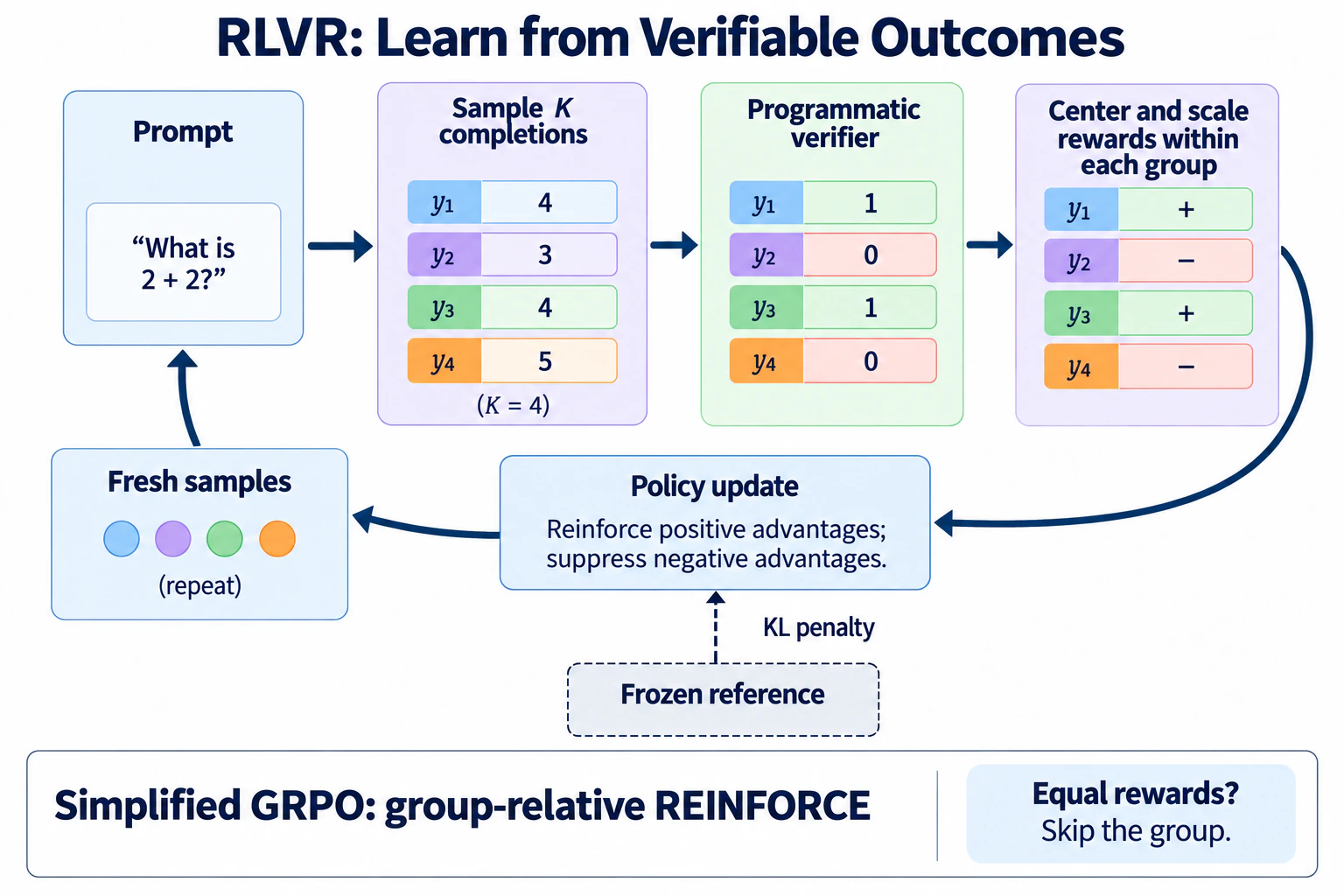
"*It doesn't matter if a cat is black or white, so long as it catches mice" - Deng Xiaoping
This is a Beyond module. Beyond modules sit outside the numbered course: nothing in Modules 00–20 depends on them, and they are not part of finishing the course. Come here in any order, whenever a model card or paper names the idea and you want the load-bearing version — built, trained, and broken on your own machine.
Before you start¶
- Review
- 13-sft for the chat template and the masked-loss discipline — both return here
- 14-dpo for the reference model and the KL intuition
- 11-sampling for the generation loop that produces the training data this time
- Finish
g2c/sft(13-sft)g2c/sampling(11-sampling)g2c/training(03b-training)g2c/lora(13b-lora) — LoRA is the required training path in this module
- Run
./baselm.shto set up the BaseLM artifact this module fine-tunesG2C_APPLY_SOLUTIONS=01-13b ./notebook.sh rlinstead of the plain launch if you're entering without your own implementations
Where this fits in¶
Every training objective in the course so far has operated on fixed examples prepared before the update: target tokens for SFT or chosen/rejected pairs for DPO. That works when someone can provide the behavior to imitate or compare.
It fails for the problems we most want models to solve — long derivations, working code, multi-step tool use — where checking an answer is easy but authoring the ideal token sequence is not. When we care more about function than form, this is also where the model's own best path to an answer may look nothing like a human demonstration.
Online reinforcement learning changes the data flow. The current model repeatedly samples attempts, an external scorer returns a numeric reward, and training updates the policy to make higher-reward behavior more likely.
Keep three axes separate:
- Feedback source: human preferences, a learned reward model, a heuristic, or a verifiable outcome.
- Data collection: fixed offline examples or fresh online rollouts.
- Optimization method: DPO, PPO, GRPO, REINFORCE-style updates, and others.
Module 14's DPO directly optimized a fixed preference dataset without an explicit reward model or online RL loop. RLHF pipelines may instead learn a reward model from human or AI preferences and optimize it with PPO or another RL method. RLVR names the reward source used here: an auditable verifier such as an answer checker, compiler, test suite, or environment-state check. These approaches coexist and can appear in different stages of the same post-training recipe.
The big idea¶
The core object in reinforcement learning is the policy being updated. For an LLM, the policy is the model's distribution over the next token. Repeated rollouts generate trajectories from task prompts, and a verifier derives a reward from each completed trajectory or its resulting environment state.
The training algorithm converts those rewards into gradient updates. A central intermediate quantity is the advantage: how much better or worse an attempt was than an appropriate baseline.
This module uses group relative policy optimization (GRPO) as its concrete method. GRPO avoids a learned value model by asking: “how did this rollout score relative to the other rollouts sampled for the same prompt?” The implementation exposes that group-relative core; it is one important RLVR optimizer, not the definition of RLVR itself.
The whole loop, which you'll implement piece by piece:
        prompt
          │
          ▼
   sample K completions          Module 11's sampler, temperature = 1
          │                      (the model writes its own training data)
          ▼
   verify each one               r_i = verifier(task, completion_i)
          │                      (an auditable outcome score)
          ▼
   group-relative advantages     A_i = (r_i − mean(r)) / std(r)
          │                      ("was this attempt better than the
          ▼                        other attempts for this prompt?")
   policy update                 raise log p(completion_i) where A_i > 0,
          │                      lower it where A_i < 0, plus a KL leash
          └───────────► repeat, always with FRESH samples
Four ideas carry it: 1) rewards instead of labels; 2) the policy gradient; 3) the group as a baseline; and 4) the KL leash (the same regularizer we covered in Module 14). Each gets a section, but each is small and simple in isolation.
This implementation is stripped down to the group-relative REINFORCE core of GRPO. Full GRPO recipes use old-policy likelihood ratios, clipping, and often multiple optimization passes across a rollout batch. Those stability mechanisms matter at scale but would complicate the estimator this module is trying to expose. The notebook and code therefore call this a simplified GRPO loop rather than claiming to reproduce a production trainer.
Rewards instead of labels¶
A supervised example specifies every token in the answer to each example. A reward specifies one number per attempt:
   SFT example:    "What is 23+58?"  →  "23+58 = 81"
   RL episode:     "What is 23+58?"  →  model writes whatever it wants;
                                        verifier returns 1.0 or 0.0
RLVR relies on verifiable rewards: scores derived by an auditable procedure from the attempt or resulting state. The notebook uses small deterministic programs—parse a final answer or check for valid JSON with a required key. Other verifiers may run compilers, test suites, proof checkers, or reproducible environment checks. No learned reward model or human preference data is used in this exercise, which keeps its failures legible: when training goes weird, the reward function is twenty lines you can read.
The deeper point: the verifier is a specification, and the model is a specification-gap-finding machine. You are not scoring what you meant; you are scoring what you specified.
The arithmetic verifier is an outcome reward: it scores the completed attempt but says nothing about how intermediate choices helped. A process reward by contrast scores selected intermediate reasoning steps, tool actions, or state transitions. This exposes denser credit on long trajectories. That can ease credit assignment and create a more recoverable learning signal, but only if those intermediate judgments are themselves reliable. A flawed process grader can create "traps" that optimize against the wrong specification. This module stays with outcome rewards.
The policy gradient in one line¶
How do you differentiate “make good attempts more likely” when sampling is not differentiable? The REINFORCE identity is:
Read it right-to-left: take the gradient that would make this completion more likely (∇ log p—a quantity you already know how to compute from Module 13) and scale it by the completion's reward. A positive raw reward pulls toward the sampled completion; a zero reward contributes no raw policy-gradient update. No gradient flows through the sampler.
Raw REINFORCE is valid but often high-variance. An action-independent baseline can reduce that variance without changing the expected policy gradient. GRPO builds a practical sampled estimator by centering and scaling rewards within the same-prompt group. Above-average attempts receive positive advantages and are reinforced; below-average attempts receive negative advantages and are pushed away. That is where a binary failure can produce a downward update even though its raw reward was zero.
GRPO: the group is the baseline¶
PPO-style LLM training commonly uses a second neural network—a value model—to estimate expected returns. Advantages compare realized returns with that learned baseline, and PPO clips policy updates for stability. GRPO removes the learned value model and estimates relative performance from the scores of other samples for the same prompt:
   rewards for one prompt's group:   r = [1.0, 0.0, 0.0, 1.0, 0.0, 1.0, 0.0, 0.0]

   A_i = (r_i − mean(r)) / std(r)   →   correct attempts get A > 0,
                                        failed attempts get A < 0,
                                        centered and scaled per group
The advantage A_i asks: was this attempt better than other attempts on the same prompt? A hard prompt where one of eight succeeds and an easy prompt where seven of eight succeed both create within-prompt contrast. No value network is needed.
One degenerate case is load-bearing. If all K rewards are equal (all failed, or all succeeded), the group carries no information. std = 0, the advantage is undefined, and no learning signal exists. The correct move is to skip that group.
This exposes the exploration boundary of verifier-based RL. A verifier is only useful when the current policy actually sees different reward outcomes. RL cannot reinforce a solution that never appears in its rollouts. Prompting, task difficulty, curriculum, sampling, and group size therefore all factor into whether a verifier produces a learning signal at all.
To complete the training gradient, the policy activation has to be translated back into per-token loss. This is just −A_i · log p(token) summed over completion tokens only. The same loss mask we learned in Module 13.
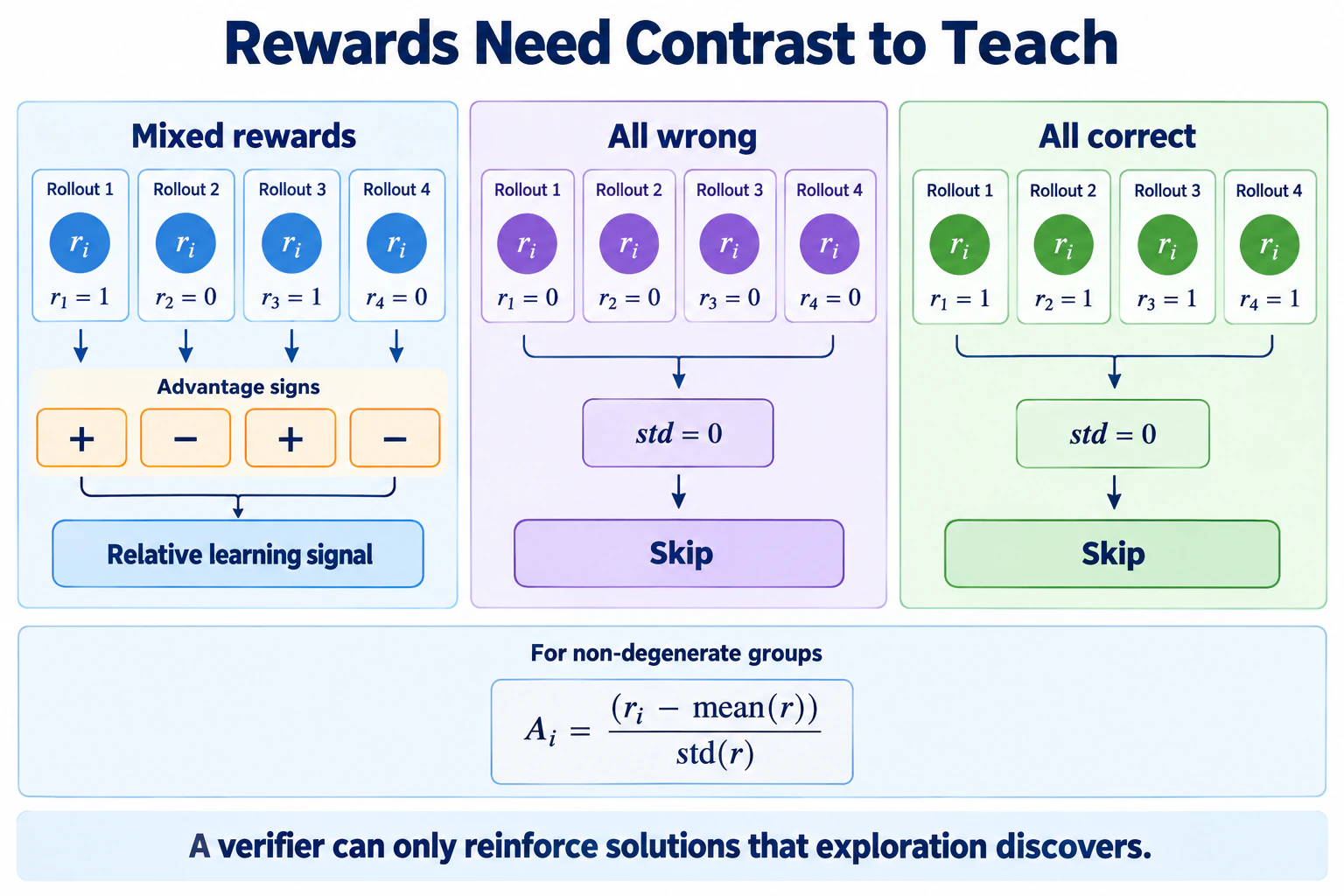 Both all-wrong and all-correct groups lack relative signal. Use the notebook's degenerate-group count to distinguish an uninformative task from a broken optimizer.
The KL leash¶
Reward optimization can trade away useful behavior that's not explicitly scored. A narrow "final answer is correct" reward, for example, gives no direct credit for readable explanations or general language quality. A standard counterweight is to add a penalty for drifting from the frozen reference model:
β sets the leash length. Too tight can suppress learning. Too loose permits drift. The reference model anchors the previously learned behavior.
Our implementation applies the nonnegative KL estimator to summed completion log-probabilities. That makes it a trajectory-level, length-sensitive teaching approximation. Production GRPO more commonly computes the estimate per token and then chooses how to aggregate across response tokens. That choice is part of the response-length story.
It's important to be aware that KL and entropy answer different diagnostic questions. KL asks how far the policy moved from the frozen reference. Sampled entropy estimates how surprising the sampled completion tokens look under the current policy. A policy can become more concentrated without moving far from an already-concentrated reference, so neither metric substitutes for the other. Some trainers add an entropy bonus to resist collapse. This module observes entropy but does not optimize it directly.
Reward hacking¶
Reward hacking is not the model cheating—it is the model finding behavior that scores well under the objective you actually wrote. A flawed reward can rise while the intended behavior does not.
If you test whether an arithmetic answer appears anywhere in the output, the model might learn to emit many numbers to maximize its chances. If you reward concision carelessly, it might emit an empty string. If the answer is available outside the intended environment, a capable agent might seek that shortcut instead of solving the task. In sufficiently permissive environments, reward hacking can become literal hacking.
The lesson in RL is central: the reward curve is just a claim. The real evidence is always independent evaluation.
RLVR in agent environments¶
Many useful LLM behaviors are agentic. As Module 19 showed, the model does not merely answer once: it selects actions, receives observations, and continues interacting with an environment.
The same RLVR machinery applies when the verifiable outcome lives in that environment. A single-turn math rollout might be scored by its final answer; a coding-agent rollout might be scored by the repository state and test results after the interaction. The reward is still verifiable, but the trajectory now includes many model actions and environment transitions.
The biggest practical challenge for agentic workloads is that the trajectories tend to be multi-turn, highly tool dependent and extremely long. For example a trajectory for a coding agent could look like:
Task: fix bug

LLM: inspect file A
ENV: <contents>

LLM: search for Foo
ENV: <search results>

LLM: edit file
ENV: patch applied

LLM: run tests
ENV: 4 failures

LLM: edit again
ENV: patch applied

LLM: run tests
ENV: all pass

reward = 1
The entire interaction history is now the rollout, but not every token in it is an action. Only tokens emitted by the policy—its messages, tool calls, or other actions—contribute log-probabilities to the policy-gradient loss. Tool results and environment observations condition later actions but must be masked out, just as prompt tokens are masked out in completion_log_prob.
An agentic rollout may contain 50 decisions. Perhaps action 7 was brilliant, action 19 was useless, action 31 nearly ruined the solution, and action 44 rescued it. A simple terminal-reward estimator nevertheless assigns the same final return to every policy action in that successful trajectory.
That long credit-assignment path motivates denser rewards, process or subgoal rewards, trajectory segmentation, search, curricula, and other guidance. This module establishes the connection but implements only short, single-turn outcome rewards.
On-policy, and why DPO was the offline cousin¶
The plain estimator above assumes samples from the same current policy whose log-probabilities appear in the update. Reusing older rollouts requires importance ratios and the controls that this simplified implementation omits. Changing sampling temperature also changes the behavior policy; this module fixes it at 1.0 so untempered generation and rescoring match. The notebook resamples every step, and generation therefore dominates its wall-clock.
This also places Module 14 precisely: DPO learns from a fixed set of preference pairs, with no fresh rollout-and-verifier loop during optimization. It avoids the generation cost and instability of an online policy-gradient loop but is bounded by the comparisons present in its dataset. DPO and online RL are different objectives, not algebraic versions of one another; the online/offline contrast explains much of their practical tradeoff.
Concepts to internalize¶
- RLVR trains against an auditable outcome signal. Checkable behavior is potentially trainable when exploration produces reward variation—that inversion is the capability unlock and the safety hazard in one move.
- The policy gradient resembles SFT on self-generated data, scaled by advantage.
∇ log pis a gradient you've computed since Module 13; the advantage decides its sign and size. - The group baseline is the "relative to what?" Centering rewards reduces variance and turns the sampled update into better-versus-worse contrast. Degenerate groups (all same reward) carry zero relative signal — skip them.
- Outcome rewards leave credit assignment to exploration. Process rewards can make the signal denser, but require trustworthy intermediate judgments.
- The KL leash limits unscored drift. The reference checkpoint anchors prior behavior while the reward pulls on the measured behavior.
- KL and entropy are not interchangeable. One measures drift from a reference; the other measures concentration of the current policy.
- Reward hacking is the objective working as written. The reward curve is a claim; the samples are the evidence. Read them every run.
- On-policy means fresh samples every step. Generation cost is not overhead — it is the method. DPO is what removing it buys and costs.
What we don't cover¶
- The full clipped GRPO surrogate. Old-policy likelihood ratios, clipping, multiple optimizer passes, and production token-aggregation choices add stability and reuse rollout batches. This module implements the group-relative REINFORCE core so the estimator remains visible.
- PPO's value-learning machinery. GAE and learned value networks are important lineage, but the group baseline lets this module omit them.
- Learned reward models and full RLHF. Training a reward model from human preferences is its own pipeline with its own failure modes (the reward model is also hackable). Programmatic verifiers let this module omit that component.
- Process supervision. Step-level rewards can improve credit assignment on long solutions, but building a reliable process grader is a separate data and evaluation problem.
- Response-length corrections. Summing versus averaging token objectives changes how response length affects an update, and GRPO variants make different normalization choices. The short capped completions here keep that issue visible in the trajectory-level KL without turning it into another implementation branch.
- Entropy regularization. The trainer reports sampled entropy as a diagnostic but does not add an entropy bonus or adapt sampling pressure during training.
- An agentic / long-horizon RL implementation. We connect the action mask and credit-assignment problem conceptually, but do not build checkpointed environments or train over multi-turn tool trajectories.
- Test-time reasoning budgets. Effort levels, budget forcing, and “thinking” modes are a decoding-and-training co-design built on top of RL-trained models; they need this module but do not fit in it.
What you'll build¶
Package: g2c/rl/
def arithmetic_choice_task(rng) -> Task                  # implemented
def format_task(rng) -> Task                             # implemented
    # task families calibrated to produce mixed groups under BaseLM

def verify_arithmetic(example, completion) -> float       # implemented
def verify_format(example, completion) -> float           # implemented
    # each ~20 lines: parse, check, return 0.0 or 1.0

def sample_group(model, tokenizer, prompt, k, ...) -> GroupSample    # implemented
    # wraps g2c/sampling: K stochastic completions at temperature 1.0,
    # returns token ids with the prompt/completion boundary marked

def group_advantages(rewards) -> Tensor:                              # SCAFFOLDED
    # (K,) rewards → (K,) advantages: center by group mean, scale by
    # group std; a degenerate group (std == 0) returns all zeros

def completion_log_prob(model, ids, prompt_len) -> Tensor:            # SCAFFOLDED
    # sum of token log-probs over the COMPLETION span only —
    # Module 13's mask seam, one more time

def grpo_loss(logp, ref_logp, advantages, kl_coef) -> Tensor:         # SCAFFOLDED
    # −(A · logp).mean() + kl_coef · KL estimate from (logp, ref_logp)

class GRPOTrainer:
    def train_step(self) -> dict[str, float]                          # SCAFFOLDED
        # sample group → verify → advantages → update if informative
        # reports reward, KL, sampled entropy, and degenerate skips
    def train(self, ...) -> dict[str, list]                           # implemented
    def evaluate(self, prompts, verifier=None) -> float               # implemented
        # greedy held-out generated pass rate; verifier override audits
        # a training reward against the intended metric
Total scaffolded code: roughly 50 lines across four locations. The trainer reuses g2c/training's optimizer plumbing. The notebook injects rank-8 LoRA adapters into the policy, freezes every base parameter, and loads a second untouched BaseLM as the reference. Each required experiment gets a fresh pair so format training cannot leak into arithmetic and the sloppy verifier is the only changed variable in its comparison.
How to run the tests¶
Tests live in tests/test_rl.py. Initial state: 8 passed (the provided verifiers, task builders, sampler validation, and trainer argument validation), 14 failed.
source .venv/bin/activate

pytest tests/test_rl.py                    # all RL tests
pytest tests/test_rl.py -x                 # stop at first failure (recommended)
pytest tests/test_rl.py -k advantages      # group-baseline tests only
pytest tests/test_rl.py -k log_prob        # completion-masking tests only
pytest tests/test_rl.py -k grpo_loss       # loss tests only
pytest tests/test_rl.py -v                 # verbose
The tests run against a tiny stub model, not BaseLM — they pin the math (zero-mean advantages, degenerate-group handling, prompt tokens excluded from completion_log_prob, loss sign conventions) so that when the notebook's real run misbehaves, you can trust the pieces and debug the loop.
Exercises¶
Open the working notebook with ./notebook.sh rl, write your answers in the Question: / Answer: cells, and ask a coding agent for hints or grading when you're ready. Partial submissions are fine because blank answers are skipped.
To launch it:
If at any point you want to archive the work in your current notebook and restart fresh:
- Build the LoRA policy and baseline it. Inject rank-8 adapters into BaseLM's query/value projections, freeze the base, print the trainable fraction, and measure greedy format pass rate on prompts excluded from training. The format prompt supplies the opening
{"answer":prefix, making both successful and failed completions discoverable by a small group sampled from a base model. The format-only verifier accepts a valid first object even if text follows it; that narrow contract is intentional and should not be mistaken for full structured-output validation. - Smoke-test the loop on format. Run ten simplified-GRPO rollout steps against
verify_format, which checks whether the model completed that prefix into a valid object. Degenerate groups count as rollout steps but not optimizer updates, so report both attempts and skips. Report held-out generated pass rate before and after; interpret training reward and degenerate-group skips as diagnostics rather than the result. - Main run: arithmetic choice. Release the format models and start from a fresh BaseLM/LoRA pair. Each two-digit addition prompt supplies two numeric options, and the model must emit the correct one. Free-response arithmetic made nearly every sampled group all-wrong in calibration; two options preserve a checkable arithmetic decision while producing enough successes and failures for group-relative learning. Report held-out generated pass rate and inspect reward, KL, sampled entropy, skips, and completions. Improvement is empirical, not promised.
- Audit a sloppy verifier. Reset to the same seeded BaseLM/LoRA initialization and change only the reward to
verify_arithmetic_sloppy. Report both sloppy and final-answer held-out pass rates and cite greedy held-out generations from the evaluated policy. Document the exploit found—or the fact that this finite run did not discover one—and patch the specification gap. The final-answer verifier scores the last emitted integer; it tests answer correctness, not strict compliance with the prompt's "only a number" wording. - Remove the KL leash (optional). Run a fresh arithmetic comparison with
kl_coef=0. Check held-out behavior, KL, sampled entropy, and generations; do not assume a short run must visibly collapse. - Group-size sweep (optional). Compare
K ∈ {2, 8, 16}at a fixed total rollout budget. Measure reward variance and degenerate-group frequency instead of assuming a universal knee.
Pitfalls to expect¶
- Log-prob over the prompt tokens. The completion mask is this module's version of Module 13's off-by-one seam. Symptom: training "works" but drifts strangely — you're reinforcing the model's opinion of the question.
- Dividing by a degenerate group's zero std. All-correct or all-wrong groups produce NaN advantages that poison the step. Skip them (and log how often — on a too-easy task, that count quietly approaches 100% and learning stops for lack of signal).
- Reading missing diagnostics as zero drift. Skipped groups do not run policy/reference rescoring, so their KL and sampled-entropy entries are
NaNand appear as plot gaps. Zero would be a false measurement. - Changing rollout temperature without changing the scorer. This simplified trainer fixes
temperature=1.0so generation and recomputed log-probabilities describe the same policy. Greedy decoding gives no exploration; another non-unit temperature would require scoring that tempered behavior policy or adding an off-policy correction. - A reference model that isn't frozen. If
p_reftracksp_θ, the KL term measures nothing and the leash is decorative. The reference is loaded once and never updated. - Trusting the reward curve. A training reward measures the verifier on sampled training attempts. The result is greedy generated pass rate on held-out prompts, scored by the intended verifier, plus the samples themselves.
- Changing initialization between verifier comparisons. If the sloppy run starts from the trained arithmetic policy or from a different random LoRA basis, more than one variable changed. The notebook reloads the base and resets the adapter seed so both arithmetic trainers begin from the same zero-delta parameters.
- Optimizing every BaseLM parameter. The required path wraps the frozen, LoRA-injected policy in
LoRAModel; handing the raw unfrozen BaseLM to the course AdamW allocates full-model optimizer state.
M-series notes¶
- Generation dominates the wall-clock. Every step samples
Kcompletions and this teaching implementation deliberately uses Module 11's readable, uncached decoding loop. The required format and arithmetic-choice completions are capped at 12 and 8 tokens respectively. Training reward can therefore improve in fewer optimizer steps while still taking longer than an SFT run with many more steps. - Memory: two frozen bases, tiny optimizer. The LoRA policy still stores and executes all BaseLM weights, and the untouched reference is a second full forward-only model. Only the adapters receive gradients and AdamW state. The notebook releases one pair before loading the next so the independent experiments do not accumulate copies.
- Use MPS when available. Rollout generation and recomputed completion log-probabilities both run the model repeatedly. Close other notebook kernels before starting a required run.
- CI note. Nothing in this module runs in per-push CI; like Modules 09B+, the training exercises are covered by pre-release dry runs.
Reading¶
Primary:
- Shao, Wang, Zhu et al., "DeepSeekMath" (2024), §4. The source of GRPO. Compare its old-policy ratio and clipped objective with the group-relative REINFORCE core implemented here.
- DeepSeek-AI, "DeepSeek-R1" (2025). Verifiable-reward RL for reasoning at a scale far beyond this module. Read §2 for the training stages and keep the difference between a reported large-scale result and this toy experiment explicit.
- Williams, "Simple Statistical Gradient-Following Algorithms for Connectionist Reinforcement Learning" (1992). REINFORCE. Skim for the identity and the baseline argument — thirty years ahead of its use case.
Secondary:
- Ouyang, Wu, Jiang et al., "Training language models to follow instructions with human feedback" (2022). The RLHF pipeline — SFT you built in 13, plus the learned reward model this module deliberately omits. Read to see what verifiable rewards let you skip.
- Schulman, Wolski, Dhariwal et al., "Proximal Policy Optimization" (2017). The lineage GRPO simplified. Read the clipping intuition; skip the implementation.
- Ahmadian, Cremer, Gallé et al., "Back to Basics: Revisiting REINFORCE-Style Optimization for RLHF" (2024). Independent evidence that the simple estimator, done carefully, competes with PPO — the same simplification pressure GRPO represents.
- Current model technical reports. Read their rollout-generation, verifier, clipping/importance-ratio, and distributed-training sections separately. Use this module to identify the loop's parts without assuming every report uses one canonical GRPO recipe.
Optional:
- Skalse, Howe, Krasheninnikov, Krueger, "Defining and Characterizing Reward Hacking" (2022). The formal treatment of Exercise 4.
- Rafailov, Sharma, Mitchell et al., "Direct Preference Optimization" (2023). Reread after this module — DPO's "your language model is secretly a reward model" argument lands differently once you've run the loop it removes.
Deliverable checklist¶
- All tests in
tests/test_rl.pypass. - Notebook: LoRA trainable-parameter count; held-out generated pass rates for the format smoke test and main arithmetic run; reward, KL, sampled-entropy, and skip diagnostics; generated samples.
- Sloppy-verifier experiment scored by both sloppy and final-answer held-out verifiers, with a written account of what the finite run found or failed to find and how to close the specification gap.
- You can separate feedback source, online/offline data collection, and optimization method—and explain why RLVR and GRPO are not synonyms.
- You can explain why RLVR can learn from an outcome verifier where SFT needs a target sequence, and what that inversion unlocks.
- You can explain — out loud, without notes — what the group baseline does to the REINFORCE estimator, and why a degenerate group teaches nothing.
- You can explain — out loud, without notes — what the KL leash limits, what this simplified loop omits from full GRPO, and how Module 14's offline DPO differs from fresh on-policy sampling.