Beyond — Muon and orthogonalized updates
Question this module answers: If initialization has to respect a matrix's geometry, why doesn't the update rule?
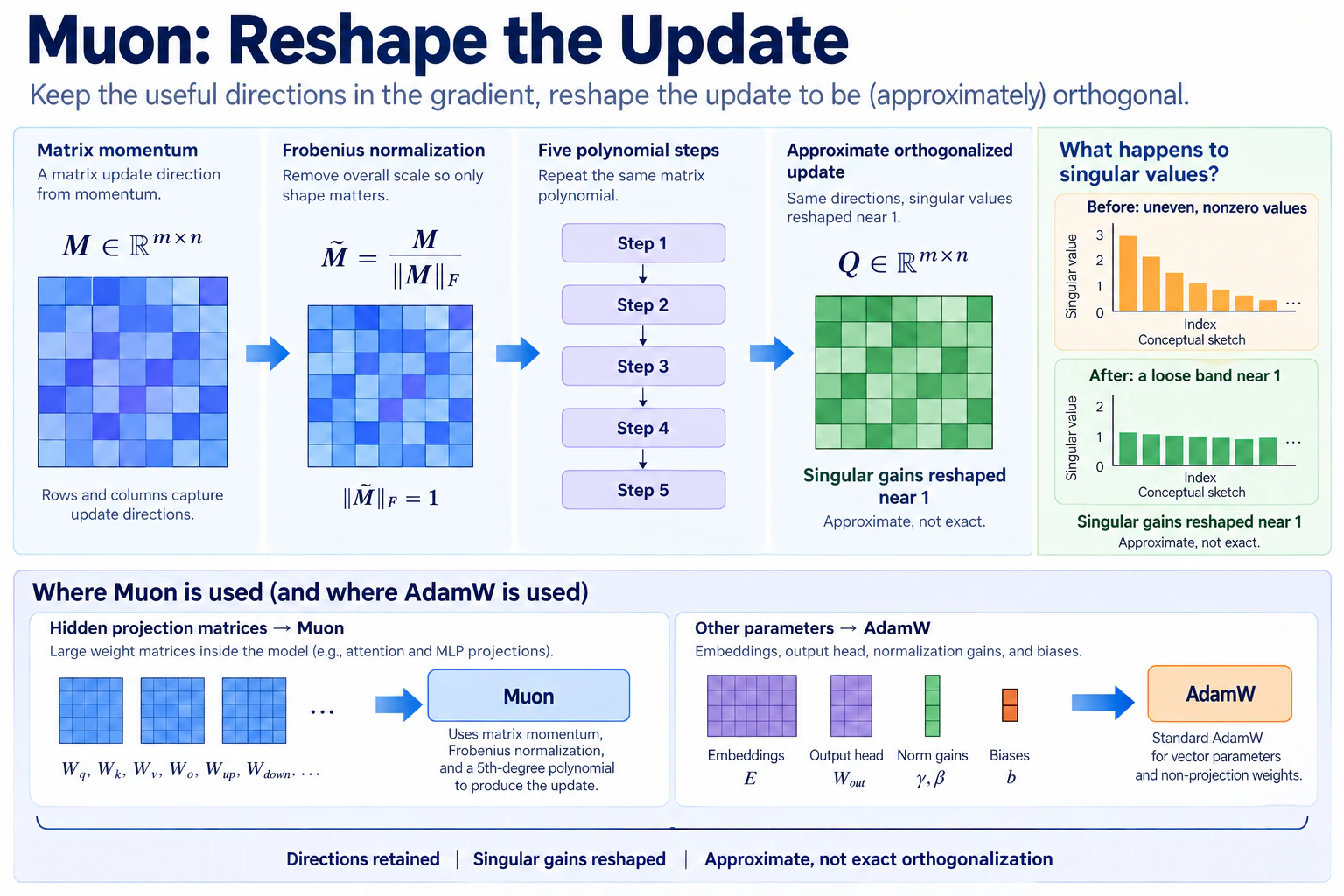
For seven years AdamW has been the default answer to "which optimizer," and Module 03B built it. In 2025–26 the default cracked at the frontier: DeepSeek V4 applies Muon to most matrix parameters and keeps AdamW for the rest; GLM-5 pretrained 28.5T tokens on a per-head "Muon Split" variant; Moonshot's Kimi K2 ran MuonClip at trillion-parameter scale. This module builds Muon — momentum, orthogonalized by a five-step polynomial iteration — races it against your own AdamW, and shows why every production deployment is a hybrid that still needs the optimizer you built in Module 03B.
This is a Beyond module. Beyond modules sit outside the numbered course: nothing in Modules 00–20 depends on them, and they are not part of finishing the course. Come here in any order, whenever a model card or paper names the idea and you want the load-bearing version — built, trained, and broken on your own machine.
Before you start
- Review
- 03-nn, the "Initializing weights" section — this module is that argument, applied to updates instead of starting points
- 03b-training for AdamW's update rule and the optimizer contract (
zero_grad/ mutablelr/step)
- Finish
g2c/training(03b-training) — Muon's non-matrix side runs yourAdamWg2c/transformer(09-transformer-block) andg2c/pretraining(09b) for the language-model race
- Run
G2C_APPLY_SOLUTIONS=01-10 ./notebook.sh muoninstead of the plain launch if you're entering without your own implementations
Where this fits in
Module 03 made a geometric argument about where weights start: an output is a sum of fan_in random terms, so the initial scale must be σ ≈ 1/√fan_in or signal explodes or dies through depth. The scale had to respect the matrix's shape.
Then Module 03B built AdamW, and the geometry quietly disappeared. AdamW treats a (fan_out, fan_in) weight as fan_out · fan_in unrelated scalars: each coordinate gets its own step size from its own gradient history, and the fact that these scalars form a matrix — that the layer's action on the residual stream is governed by that matrix's directions and gains — plays no role in the update at all.
Muon puts the geometry back. A momentum matrix, like any matrix, has singular directions with unequal gains: a few directions carry most of the update's energy while the rest barely register. Muon orthogonalizes the momentum before applying it — pushes every singular value toward 1 — so a step moves the weight along all of the update's directions at comparable magnitude, not just the loudest ones. In the steepest-descent picture: AdamW takes the best step under a per-coordinate metric, Muon under a spectral one, which is the natural metric for an object whose job is to be a linear map.
The reason this is now worth a module rather than a footnote is the recurrence at the top of the page: three independent frontier families train on it, and it admits a complete laptop-scale build — the whole optimizer is momentum plus five iterations of three small matmuls.
The big idea
Take the momentum buffer M for one weight matrix and imagine its SVD, M = U S Vᵀ. The update Muon wants is U Vᵀ — same directions, all gains set to 1. Computing an SVD every step is far too slow, and here is the trick that makes Muon practical: you can move every singular value without ever finding them.
For any odd polynomial f, applying the matrix expression
acts on X = U S Vᵀ as U f(S) Vᵀ — the singular vectors pass through untouched, and f hits each singular value separately. Muon iterates one fixed quintic, f(s) = 3.4445·s − 4.7750·s³ + 2.0315·s⁵, five times:
   normalize:  X ← M / ‖M‖_F        singular values now in (0, 1]

   spectrum:   |▁▂▂▃█ ...           a few large, many tiny

   f, ×5:      steep near 0  →  small gains amplified hard
               fixed point ≈ 1  →  large gains parked near 1

   result:     |▆▇█▇▆ ...           a loose band around 1 ≈ U Vᵀ
Three properties fall out, and the test suite pins each one:
- Scale invariance. The Frobenius normalization means
NS(G) = NS(7G): Muon's step direction is completely indifferent to gradient magnitude. (AdamW is also approximately scale-invariant, but per-coordinate; Muon is invariant as a matrix.) - Direction preservation. An input whose singular values are already equal — an orthogonal matrix — comes back as a scalar multiple of itself.
- Rectangular compensation. An orthogonalized
(rows, cols)update has RMS entry~1/√rows, so Muon scales the step by√(max(1, rows/cols))to keep per-entry step sizes comparable across differently-shaped layers.
The partition: Muon is a hybrid by construction
Orthogonalization is defined for matrices, and meaningful for matrices whose rows and columns jointly implement one linear map. That excludes more than the 1-D parameters:
- Vectors and scalars — norm gains, biases — have no singular structure. Nothing to orthogonalize.
- Embedding tables are 2-D but are really
Vunrelated per-token rows stacked together. Orthogonalizing mixes row2041's update into row7's — tokens that may never appear in the same batch. The unembedding has the same problem transposed.
So every production Muon is Muon-for-projections plus AdamW-for-the-rest, and this module's Muon class is honest about it: you hand it two parameter lists, and the second is driven by an internal g2c.training.AdamW — literally your Module 03B implementation, composed rather than replaced. Deciding which parameters go in which list is not plumbing; it is the design decision, and the notebook makes you take it (and then violate it, to see why the rule exists).
What it costs, what it saves
Per matrix, Muon keeps one state buffer (momentum) where AdamW keeps two (m and v) — Module 13B's memory-tenant arithmetic, revisited: the optimizer-state line halves for every parameter on the Muon side. Per step it adds five iterations of three matmuls on a matrix the size of the weight — for the course's models, microseconds. The practical cost is subtler and shows up in the notebook: Muon's useful learning-rate range is far from AdamW's (unit-scale updates want lr around 0.02–0.05, not 3e-4), so any fair comparison must sweep both — a single-lr race is rigged and the exercises treat it as such.
Concepts to internalize
- Updates have geometry. A weight update is a matrix with directions and gains, not a bag of scalars. AdamW adapts per-scalar; Muon normalizes per-direction.
- Odd polynomials edit spectra blind.
a·X + b·(XXᵀ)X + c·(XXᵀ)²Xappliesfto every singular value without computing any of them. Five iterations of three matmuls replace an SVD. - Normalize first. The quintic converges for spectra in (0, 1]; the Frobenius division puts them there. Skip it and the iteration diverges — the classic implementation bug.
- Gradient magnitude is discarded; direction is everything. Muon's step from gradient
gand from100gis identical. That is a feature — and the reason its lr means something different than AdamW's. - The partition is the design. Matrices-that-are-maps get Muon; embeddings, vectors, and the head stay on AdamW. Every frontier deployment is this hybrid.
- Model-card literacy: "Muon," "Muon Split," "MuonClip," and an optimizer section that assigns different rules to different parameter groups all signal the same underlying move — a spectral update rule for the network's linear maps.
What we don't cover
- Distributed Muon. Newton–Schulz needs whole logical matrices, which collides with sharded training; DeepSeek's hybrid-ZeRO adaptation and Moonshot's scalability work are systems engineering on top of the mechanism built here.
- MuonClip and stability at scale. Kimi K2's qk-clip addresses attention-logit blowups at trillion-parameter scale — an interaction this module's model sizes cannot reproduce.
- The Nesterov variant and low-precision Newton–Schulz. Production implementations run NS in bfloat16 with a Nesterov-flavored momentum read; we keep plain heavy-ball in float32 so the mechanism stays inspectable.
- Steepest descent under general norms. Bernstein & Newhouse's framework (every optimizer is steepest descent under some norm) is the right theory lens; we take only its intuition.
- Second-order ancestors. Shampoo and K-FAC precondition with curvature estimates; Muon's orthogonalization is cheaper and closer to a normalization than a curvature model. The family resemblance is worth knowing about, not building.
What you'll build
Package: g2c/muon/
NS_COEFFS = (3.4445, -4.7750, 2.0315)

def zeropower_via_newtonschulz(G, steps=5): ...   # SCAFFOLDED
    # normalize → (transpose if tall) → five quintic passes → ≈ U Vᵀ

class Muon:
    def __init__(self, muon_params, adamw_params, lr=0.02, *,
                 momentum=0.95, weight_decay=0.0, ns_steps=5,
                 adamw_lr=3e-4, ...): ...          # implemented
    # validates every muon param is 2-D; builds momentum buffers;
    # wraps adamw_params in your g2c.training.AdamW
    def zero_grad(self): ...                       # implemented
    def step(self): ...                            # SCAFFOLDED
        # m ← μ·m + grad;  O = NS(m);
        # p ← (1 − lr·wd)·p − lr·√max(1, rows/cols)·O;
        # then one AdamW step for the other group
Total scaffolded code: roughly 25 lines across the two functions. The external interface matches SGD/AdamW — zero_grad(), mutable lr, step() — so it drops into Module 10's trainer unchanged.
How to run the tests
Tests live in tests/test_muon.py. Initial state: 3 passed (construction, the 2-D validation, zero_grad), 14 failed. The AdamW-side test drives the internal g2c.training.AdamW, so it needs Module 03B's optimizer (yours, or G2C_APPLY_SOLUTIONS=03b).
source .venv/bin/activate

pytest tests/test_muon.py                    # all module tests
pytest tests/test_muon.py -x                 # stop at first failure (recommended)
pytest tests/test_muon.py -k newton_schulz   # the orthogonalizer alone
pytest tests/test_muon.py -k step            # the optimizer step
The signature test: test_muon_update_is_gradient_scale_invariant feeds the same parameter a gradient and 100× that gradient and demands identical steps. A missing Frobenius normalization, a wrong coefficient order, or momentum applied after orthogonalization all break it loudly; the three newton_schulz sanity anchors (band, orthogonal-direction preservation, transpose consistency) localize which piece went wrong.
Exercises
To launch the exercise notebook run:
If at any point you want to archive the work in your current notebook and restart fresh:
Written exercises live in the notebook as Question: / Answer: cells; ask a coding agent for hints or grading when you're ready, and partial submissions are fine — blank answers are skipped.
- Watch the spectrum flatten. Run a random matrix through 1, 2, 3, and 5 Newton–Schulz passes and plot the singular-value spectrum after each. Identify what one pass does to values near zero and near one.
- AdamW's update versus Muon's, geometrically. Build a nearly rank-1 momentum matrix (an early-training shape), compute both optimizers' update directions, and compare their spectra. Which directions does each spend its step on?
- The race, run fairly. Train the same char-level TinyShakespeare transformer under AdamW and under Muon (proper partition), each at its own best learning rate from a small sweep. Report curves, the winner, and how sensitive the result was to lr.
- The learning-rate landscape. From the sweep data: how far apart are the two optimizers' best learning rates, and which degrades more gracefully when the lr is wrong by 3×?
- Violate the partition. Route the embedding table and unembedding through Muon deliberately and rerun the race. Explain what you observe using the rows-are-unrelated-objects argument — or report honestly if the toy scale hides the damage.
- Written: the state bill. For your race model, compute optimizer-state memory under AdamW-everything versus the Muon hybrid, and connect the arithmetic to Module 13B's memory-tenant table.
Pitfalls to expect
- Skipping the normalization. Without the Frobenius division the quintic diverges within a few iterations — exploding entries, NaNs, or a spectrum band test failing with values in the hundreds.
- Coefficient order.
(a, b, c)multiplyX,(XXᵀ)X, and(XXᵀ)²Xrespectively. Swapped coefficients still produce plausible-looking matrices; the orthogonal-direction anchor is what catches them. - Racing at one shared learning rate. At AdamW's
3e-4, Muon barely moves; at Muon's0.02, AdamW diverges. Every fair comparison in this module is best-of-sweep versus best-of-sweep. - Orthogonalizing the momentum buffer in place.
stepmust keep the raw momentum for the next iteration and apply the orthogonalized copy. Mutating the buffer changes the trajectory subtly — losses still fall, just worse — which makes it the nastiest bug here. svdvalson MPS. Compute spectra on CPU tensors in the notebook; MPS support for SVD-family ops is spotty and can silently fall back or error.- Reading one seed as a verdict. The race exercises are short runs on small models; rerun with a second seed before concluding an optimizer "wins," and report both.
M-series notes
- Newton–Schulz is cheap at course scale. Five iterations of three matmuls per matrix per step adds low single-digit percent overhead to the race runs; do not pre-optimize it.
- The races are the module's compute cost — a few thousand char-level TinyShakespeare steps per configuration, minutes each on MPS. Plug in for the sweep cells.
- Spectrum plots run on CPU (see pitfalls). The matrices involved are tiny; there is nothing to accelerate.
- TinyShakespeare ships with
./setup.sh— no additional downloads for this module.
Reading
Primary:
- Jordan, "Muon: An optimizer for hidden layers of neural networks" (2024). The original write-up — the quintic coefficients, the rectangular scale factor, the empirical case, and the explicit hidden-layers-only scope. This module is this post, built.
- Bernstein & Newhouse, "Old Optimizer, New Norm: An Anthology" (2024). The theory frame: familiar optimizers as steepest descent under different norms, with Muon as descent under the spectral norm. Read for the lens, not the proofs.
Secondary:
- Moonshot AI, "Muon is Scalable for LLM Training" (2025). MuonClip and the engineering that took Muon from speedrun to Kimi K2's trillion-parameter pretraining — the paper that moved it from curiosity to production evidence.
- Gupta, Koren, Singer, "Shampoo: Preconditioned Stochastic Tensor Optimization" (2018). The nearest ancestor: full-matrix preconditioning per tensor. Useful contrast for what Muon doesn't compute.
Optional:
- The current release lineage. GLM-5's report (Muon Split, 28.5T tokens) and DeepSeek V4's optimizer section (Muon for most matrices, AdamW for embeddings, head, norms, and residual-mixing parameters) — both from 2026. After this module, those parameter-assignment tables read as the partition exercise, deployed.
Deliverable checklist
- All tests in
tests/test_muon.pypass — the gradient-scale-invariance signature especially. - Notebook: the spectrum-flattening plot (Exercise 1), the geometric AdamW/Muon comparison (Exercise 2), and the fair two-sweep race with curves (Exercises 3–4).
- The partition-violation run, with an honest reading of what it did or didn't show (Exercise 5).
- Written answer for the optimizer-state bill (Exercise 6).
- You can explain — out loud, without notes — what Newton–Schulz does to a momentum matrix's singular values and vectors, and why normalization must come first.
- You can explain — out loud, without notes — why Muon's step ignores gradient magnitude, and what that does to its learning-rate scale.
- You can explain — out loud, without notes — why embeddings and norm gains stay on AdamW in every production deployment.
- You can explain — out loud, without notes — how this module's argument continues Module 03's initialization story.