Beyond — Midtraining: continued pretraining and data mixtures
Question this module answers: How can continued next-token training add a capability without erasing what the base model already knows?
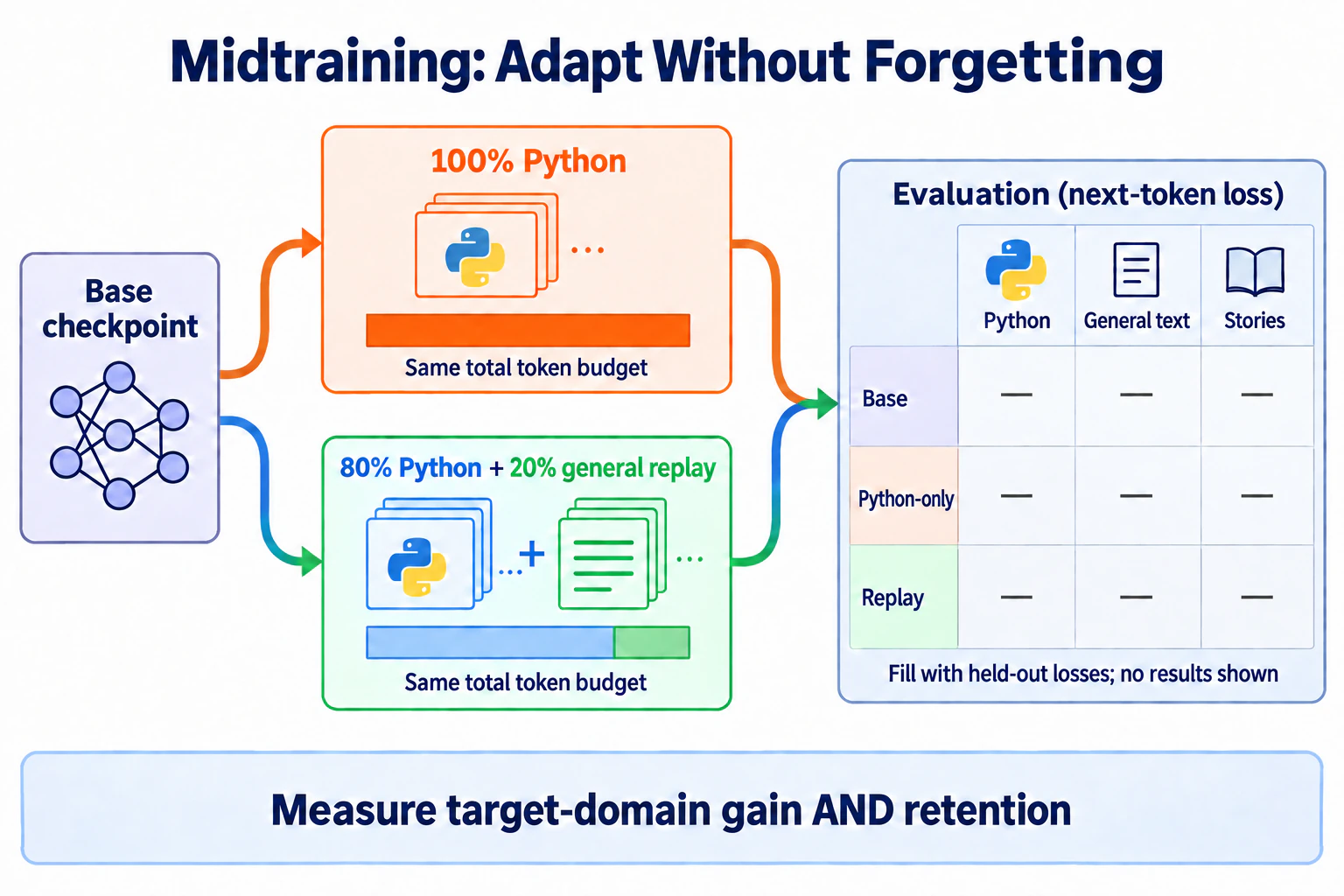
Pretraining built a general next-token predictor; post-training will teach it how to answer. Between those stages, modern model recipes often continue the same pretraining objective on a deliberately changed distribution: more code, mathematics, another language, longer sequences, or synthetic capability data. This module makes that middle stage concrete. You will fork TinyLLM-30M-base into equal-token Python-only and Python-plus-replay runs, then measure the bargain each branch made across code, general text, and stories.
This is a Beyond module. Beyond modules sit outside the numbered course: nothing in Modules 00–20 depends on them, and they are not part of finishing the course. Come here in any order, whenever a model card or paper names the idea and you want the load-bearing version built and broken on your own machine.
Before you start
- Review 09B-pretraining for causal language-model loss and 10-tinyllm for the trainer and durable checkpoint
- Review 13-sft for the objective boundary this module sits immediately before
- Finish
g2c/pretraining,g2c/training, andg2c/transformer - Run
./datasets.sh --smallfor G2C Corpus v1 and./checkpoints.sh tinyllm-30mfor the required base checkpoint - Run
G2C_APPLY_SOLUTIONS=01-10 ./notebook.sh midtraininginstead of the plain launch if you are entering without your own implementations
Where this fits in
The main course moves from scaling experiments in Module 12 to supervised instruction tuning in Module 13. That is a clean teaching arc, but production model development often inserts another stage. The model continues predicting the next token, now under a data distribution chosen to strengthen particular capabilities before alignment begins.
Names vary. Continued pretraining, domain-adaptive pretraining, second-stage pretraining, and midtraining overlap without being perfect synonyms. This module uses midtraining as the umbrella and implements one precise case: domain-adaptive continued pretraining on Python with general-data replay.
The distinction from SFT is objective-level, not marketing-level:
   pretraining / midtraining                 supervised fine-tuning
   ─────────────────────────                 ──────────────────────
   raw token stream                          prompt + response examples
   predict every next token                  mask prompt; train on response
   changes knowledge/capability mix          teaches prompted behavior
   no assistant role is required             chat template is part of data
If a run uses raw Python and ordinary causal loss, it is continued pretraining even if it is short. If it uses instruction/response records and response masking, it is SFT even if it updates every weight. The objective and data contract define the stage.
The big idea
Midtraining changes a model by changing what it continues to predict. That sounds almost too simple, but it creates a three-way design problem:
   target-domain gain
          ▲
          │       ● Python-only
          │     ╱
          │   ● replay mixture
          │ ╱
          ●──────────────────► retained general capability
        base

   compute is fixed: moving along the frontier changes which tokens
   receive the training budget, not how much compute the run gets
The Python-only branch spends every update on the new domain. It should adapt fastest and has no direct pressure to preserve the old distribution. The replay branch spends 80% of the same token budget on Python and 20% on non-code examples from the base corpus. It gets fewer Python tokens, deliberately, in exchange for a continuing gradient from the old world.
Same objective, new distribution
For a token sequence x₁ … x_T, nothing about the loss changes:
Only the source distribution changes:
That makes the data mixture a model-design parameter. TokenMixture samples each batch row from one source, then samples a contiguous language-model window inside that source. It never concatenates Python and prose before choosing windows; doing so would manufacture fake boundary transitions and train on them.
The 80/20 ratio is a course default, not a universal recipe. Source similarity, base-model maturity, target-domain size, learning rate, and token budget all move the frontier. The optional sweep treats the ratio as the empirical variable it is.
Equal tokens make the comparison honest
Both required branches receive exactly:
This is an equal-total-token comparison. The branches use approximately equal compute, but the replay branch sees only about 80% as many Python tokens. That sacrifice is the intervention we want to measure.
An equal-Python-token comparison would answer a different question. It would give the replay branch additional general tokens and therefore additional compute. Useful for deployment planning, perhaps, but not a clean test of what replay buys under a fixed budget.
TokenMixture implements 80/20 in expectation by choosing a source independently for each batch row. A batch of four cannot literally contain 3.2 Python examples. The notebook records realized fractions over the run; enough batches converge toward the configured ratio. Reproducibility comes from the trainer's seeded generator, including across checkpoint resume.
Adaptation and forgetting are both gradients
Catastrophic forgetting sounds like a special failure mechanism. Here it is the ordinary optimizer doing exactly what it was asked to do. Every Python-only gradient improves predictions under D_python; nothing in that objective rewards preserving predictions on stories or general prose. Shared parameters move toward the new distribution, and old-domain loss can rise.
Replay adds old-domain gradients back into the update. It does not freeze general capability or guarantee preservation; it changes the expected gradient:
That equation is the module. At large scale, teams spend enormous effort choosing the distributions represented by those expectation signs.
Restart the optimizer gently
The base checkpoint finished a long cosine decay near a small learning rate. A new stage needs a new schedule horizon, but restarting at the original pretraining peak can damage useful weights before the new distribution has supplied a stable direction.
The required run uses AdamW, a short 20-step rewarm, 2e-5 peak learning rate, and cosine decay to 2e-6—one tenth of the base run's 2e-4 peak. This is a calibrated laptop recipe, not a scaling law. The principles are more durable:
- use a fresh optimizer state unless the continuation is truly one uninterrupted run;
- rewarm briefly rather than applying the peak update immediately;
- use a lower peak for adaptation than for training the same model from random initialization;
- compare runs at the same token budget and schedule.
Evaluate a matrix, not the training loss
Training loss answers “how well did this branch predict the distribution it sampled?” It cannot measure a domain the branch never sees. The notebook freezes three validation streams before either branch trains:
| Domain | What it measures |
|---|---|
| held-out CodeSearchNet Python | target-domain adaptation |
| held-out FineWeb-Edu + Cosmopedia | general-text retention |
| held-out TinyStories | retention on a visibly different style |
Each checkpoint—base, Python-only, replay—runs on the exact same seeded windows. Report absolute loss and change from base. Lower Python loss is adaptation; positive general/story deltas are forgetting; replay succeeds when it moves those retention deltas toward zero without surrendering all of the target gain.
Reference calibration at 307,200 tokens produced the intended small but measurable pattern: Python-only gained slightly more on Python while general and story loss rose; 80/20 replay preserved those domains while retaining most of the Python gain. Your exact values may differ with MPS kernels and checkpoint provenance. The direction and the evidence matter more than matching decimals.
Samples are secondary evidence. A 30M base model does not become a capable coding assistant after 300 steps. Fixed code and prose prompts can reveal local syntax or style shifts, while a Python ast.parse rate may be reported as experimental if it has enough non-degenerate signal. Do not replace held-out loss with a handful of attractive generations.
Long-context extension is also midtraining
Domain adaptation is only one use of this stage. A model can also continue next-token training on longer sequences, dependency-bearing data, and a new positional regime. That makes long-context extension a form of midtraining, but not a small subtopic of it: accepting a longer tensor, representing positions beyond the training range, learning to use distant evidence, paying the attention bill, and evaluating retention are separate problems.
Beyond Long Context owns that complete stack, including RoPE scaling, NoPE, length curricula, and long-versus-short evaluation. This module keeps the stage boundary: when those changes use raw-token causal loss, they are continued pretraining rather than SFT.
Concepts to internalize
- Midtraining keeps the base objective and changes its distribution. Raw-token causal loss distinguishes it from response-masked SFT.
- Mixture weights are model-design parameters. They trade target exposure for retention gradients.
- Equal total tokens are the fairness control. Equal target tokens would grant replay extra compute.
- Forgetting is an expected consequence, not a mysterious bug. The new objective contains no old-domain preservation term unless replay supplies one.
- Evaluate every affected domain. In-domain loss alone can make destructive adaptation look unambiguously successful.
- Long-context extension can be midtraining. The objective remains next-token prediction while sequence length, data, and often position handling change.
What we don't cover
- Long-context mechanics. Beyond Long Context covers position handling, curricula, utilization, and evaluation as one system.
- Tokenizer adaptation. All branches retain
G2CTokenizer, isolating weight adaptation. Adding vocabulary changes embeddings and creates a different experiment. - Instruction or preference tuning. Modules 13–14 cover those objectives after the base-capability stage.
- Synthetic capability curricula. Mathematics and reasoning midtraining often use generated data; synthetic data teaches the quality-control side separately.
- A universal replay ratio. The optional sweep demonstrates why none exists.
What you'll build
Package: g2c/midtraining/
class TokenMixture:                                      # boilerplate provided
    sources: dict[str, TokenSource]
    weights: Tensor
    example_counts: dict[str, int]

    def get_lm_batch(                                    # scaffolded
        self, batch_size, context_length, *, generator=None
    ) -> tuple[Tensor, Tensor]: ...

def evaluate_domain_losses(                              # scaffolded
    model, domains, *, batch_size, context_length,
    eval_iters=20, device="auto", seed=0,
) -> dict[str, float]: ...
The notebook reuses Module 10's Trainer, checkpoint-resume plumbing, G2CTokenizer, and TinyLLM-30M-base. Source-specific decompression/tokenization and plotting live in g2c/notebook_extras/midtraining.py; they are plumbing, not student work.
The durable outputs are:
Both manifests name TinyLLM-30M-base as their parent and record source mixture, token budget, schedule, seed, and realized branch configuration.
How to run the tests
source .venv/bin/activate

pytest tests/test_midtraining.py
pytest tests/test_midtraining.py -x
pytest tests/test_midtraining.py -k mixture
pytest tests/test_midtraining.py -k evaluate
The tests use tiny in-memory token streams and a deterministic stub model. No corpus, checkpoint, MPS device, or network is needed.
Initial scaffold state: 5 passed, 10 failed. Constructor and validation plumbing starts green; mixture sampling and per-domain evaluation turn green in the suggested order from the test-file header.
Exercises
Open the working notebook with ./notebook.sh midtraining (or ./notebook.sh midtraining --fresh to reset from the clean scaffold), write answers in the Question: / Answer: cells, and ask a coding agent for hints or grading. Partial submissions are fine because blank answers are skipped.
- Establish the base. Load
TinyLLM-30M-base, build frozen Python/general/story validation streams, and record its three-domain loss row. - Build the mixture. Implement
TokenMixture.get_lm_batch, inspect source-pure rows, and verify that realized 80/20 fractions converge over many batches. - Run equal-token branches. Fork the same base checkpoint into 100/0 and 80/20 runs. Train each for 300 × 4 × 256 = 307,200 tokens with the same schedule and seed.
- Measure adaptation versus retention. Implement
evaluate_domain_losses; build the three-checkpoint × three-domain table and delta plot. - Inspect behavior carefully. Compare fixed Python and prose continuations. Optionally report syntax-validity as an experimental metric, but interpret it alongside loss and raw samples.
- Sweep replay ratio (optional). Compare 100/0, 90/10, 80/20, and 50/50 under a shorter equal-token budget. Plot the adaptation-retention frontier rather than choosing a winner by one domain.
Pitfalls to expect
- Starting one branch from the other. Both must fork the identical base checkpoint or the comparison is sequential training, not a controlled branch.
- Equalizing Python tokens instead of total tokens. That gives replay extra compute and answers a different question.
- Building windows across corpus boundaries. Sample a source first, then a window inside it.
- Reporting configured rather than realized mixture. Small batches fluctuate; record the observed allocation.
- Evaluating on training slices. Improvement there can be memorization. Validation shards are fixed before training.
- Calling lower Python loss an unconditional win. The retention columns are part of the result.
- Restarting at the original peak learning rate. A mature checkpoint needs a gentler continuation schedule.
- Calling a larger context limit long-context capability. Utilization must be trained and evaluated.
M-series notes
- Required training is short but real. On the calibration machine, the two 307,200-token branches took roughly five minutes combined on MPS, plus tokenization and evaluation. Hardware and background load vary.
- Memory is dominated by the 30M model, optimizer state, and activations. The required
B=4, T=256configuration is intentionally conservative for 16GB machines. - Source tokenization is bounded. The notebook reads 8MB per training domain and 1MB per validation domain rather than materializing G2C Corpus v1.
- Checkpoints are resumable. Rolling state lives under
data/work/beyond-midtraining/; durable completed models live underartifacts/models/.
Reading
Primary:
- Gururangan, Marasović, Swayamdipta et al., “Don't Stop Pretraining: Adapt Language Models to Domains and Tasks” (2020). Domain- and task-adaptive pretraining, and the cleanest historical framing for this module.
- Parmar, Satheesh, Patwary et al., “Reuse, Don't Retrain: A Recipe for Continued Pretraining of Language Models” (2024). Data-distribution and learning-rate guidance for continuing mature checkpoints.
- Elhady, Agirre, Artetxe, “Emergent Abilities of Large Language Models under Continued Pretraining for Language Adaptation” (2025). Why target-language perplexity can conceal broader capability loss and why replay matters.
Deliverable checklist
- All tests in
tests/test_midtraining.pypass. - Both branches start from the identical
TinyLLM-30M-baseartifact and consume 307,200 tokens. - Both derived artifacts are saved with parent lineage and mixture metadata.
- Notebook contains the three-checkpoint × three-domain loss table and delta plot.
- Fixed Python and prose samples are shown without treating isolated attractive output as the primary metric.
- You can explain why equal total tokens, not equal Python tokens, is the fairness control used here.
- You can explain why replay changes the expected gradient and why it cannot guarantee zero forgetting.
- You can explain why a raw-token long-context continuation belongs on the midtraining side of the SFT boundary.